

Table of Contents
Market Context
What Happened
Why It Matters
Sector Breakdown
Risks to Watch
What to Watch Next
Final Outlook
Market Context
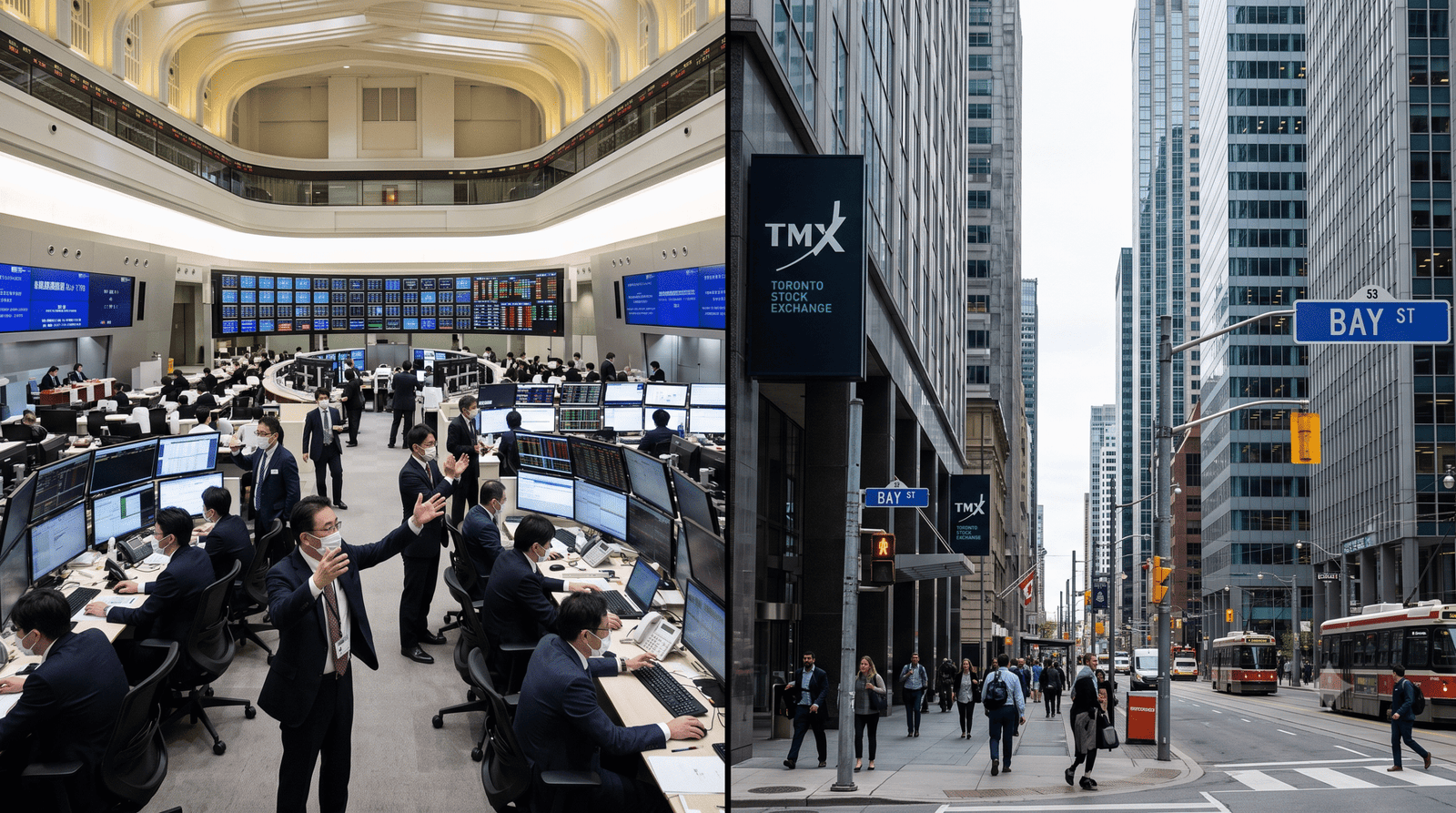
Global stock markets operate on a continuous, rolling schedule shaped by time zones, with trading activity moving from east to west across the trading day. The cycle typically begins with markets in Sydney and Tokyo, followed by Hong Kong and Shanghai, then India, then Europe, and finally North America, including the TSX and NYSE. Because more than 60 major exchanges operate around the world, there is almost always some market open at any given hour, but trading volume and volatility are not evenly distributed across this cycle.
For Canadian investors, understanding these patterns matters because overnight developments in Asian or European markets can shape the opening tone for the TSX, while news that breaks during TSX trading hours can, in turn, influence how Asian markets open later that day. The TSX and NYSE share identical regular trading hours, 9:30 a.m. to 4:00 p.m. Eastern Time, Monday through Friday, while major Asian exchanges such as Tokyo, Hong Kong, and Shanghai include midday lunch breaks that pause trading for part of the session. The London Stock Exchange, by contrast, operates a much longer session, from 8:00 a.m. to 4:30 p.m. UK time, and only pauses briefly around midday.
The period when London and New York markets are both open, broadly between 8:00 a.m. and noon Eastern Time, is often described as the busiest overlap window globally, accounting for a disproportionate share of trading volume across many asset classes.
Also Read: Best long term Canadian stocks
What Happened
Over the past 24 hours, the global trading cycle illustrated these dynamics clearly. News that the United States and Iran had reached a preliminary peace agreement broke over the weekend and was first reflected in Asian trading on Monday, where equity markets rallied sharply, oil prices tumbled, and the US dollar weakened against major currencies including the euro and British pound. By the time London and European markets opened, this risk-on tone had already been established, with European indices including the FTSE 100, DAX, and CAC 40 all posting solid gains.
By the time North American markets opened, including the TSX and NYSE, US equity futures were already pointing higher, with inflation expectations cooling as the prospect of an oil-driven price shock receded. On the TSX specifically, the S&P/TSX Composite Index gained on the day, with financials and mining names leading, while energy stocks lagged as the overnight decline in oil prices fed through to Canadian producers. This sequencing — overnight Asian reaction, followed by a European confirmation, followed by a North American open already pricing in the move — is a common pattern for major overnight geopolitical news.
Why It Matters
Overnight News Sets the Tone for TSX Openings
For TSX investors, a significant share of major market-moving news, particularly geopolitical developments, tends to break outside of Canadian trading hours. This means that by the time the TSX opens at 9:30 a.m. Eastern Time, much of the initial price discovery for a major overnight event has already occurred in Asian and European markets. Canadian investors are, in effect, often reacting to a reaction, which can influence how much of a move is “left” for TSX-listed names by the time domestic trading begins.
The London-New York Overlap Remains the Most Liquid Window
The period when both London and New York are open is widely regarded as the most liquid and often most volatile window for global equity and currency markets. For TSX investors with exposure to US-listed companies, or who trade Canadian dollar pairs, this overlap period can be particularly relevant, as it tends to see the highest trading volumes and can produce sharper intraday moves than other parts of the trading day.
Sector Breakdown
The sequencing of the US-Iran news illustrates how different sectors responded as the story moved across time zones. In Asian trading, the initial reaction was concentrated in currencies, commodities, and broad equity indices, with oil prices falling sharply and gold rising to a weekly high as investors repositioned. By the European session, the reaction had broadened into specific equity sectors, with European indices posting gains across the board.
By the North American open, the TSX’s sector-specific reaction became visible: financials including TD Bank, BMO, and RBC advanced as the reduced inflation risk eased concerns about Bank of Canada policy, mining names including Agnico Eagle and Barrick posted gains, and energy stocks including Imperial Oil declined as the overnight drop in crude prices was reflected in Canadian producer valuations. This progression — currencies and commodities first, broad indices second, sector-specific moves last — is a recognizable pattern for how major overnight news typically flows through the global trading day.
Also Read: Top Canadian tech AI stocks
Risks to Watch
The main risk for investors relying on overnight or pre-market signals is that initial reactions in one time zone do not always persist by the time other markets open. Sentiment can shift, additional news can emerge, or initial moves can be partially reversed as more investors weigh in during subsequent sessions. Additionally, while the London-New York overlap is generally the most liquid period, higher liquidity does not eliminate volatility, and sharp moves during this window can still catch investors off guard. For TSX investors specifically, the exchange’s relatively concentrated sector weighting means that global news affecting commodities or financials can have an outsized effect on the Canadian benchmark relative to more diversified global indices.
What to Watch Next
Investors should pay attention to how Asian markets react to ongoing developments around the US-Iran agreement, particularly in the lead-up to its expected implementation later this week, as this is likely to continue shaping the tone for European and North American sessions. The London-New York overlap period will remain a useful window for monitoring how Canadian dollar and TSX-related sentiment evolves relative to US markets. More broadly, any significant data releases or central bank communications scheduled for specific time zones should be considered in the context of how their timing may affect when and how markets initially react.
Final Outlook
The continuous, rolling nature of global stock market trading means that for TSX investors, much of the context for a given trading day is often set well before the Canadian market opens. The past 24 hours offered a clear example of this, with a major geopolitical development working its way from Asian markets through Europe and into North American trading, with sector-specific effects becoming most visible once the TSX and NYSE opened.
Understanding this sequencing does not provide a trading edge in itself, but it can help investors interpret why the TSX might open higher or lower on a given day, and which sectors are likely to be most directly affected by overnight developments.
Sign Up For our Newsletters to get latest updates