


Table of Contents
- Market Context
- What Happened
- Why It Matters
- Sector Breakdown
- Risks to Watch
- What to Watch Next
- Final Outlook
Market Context
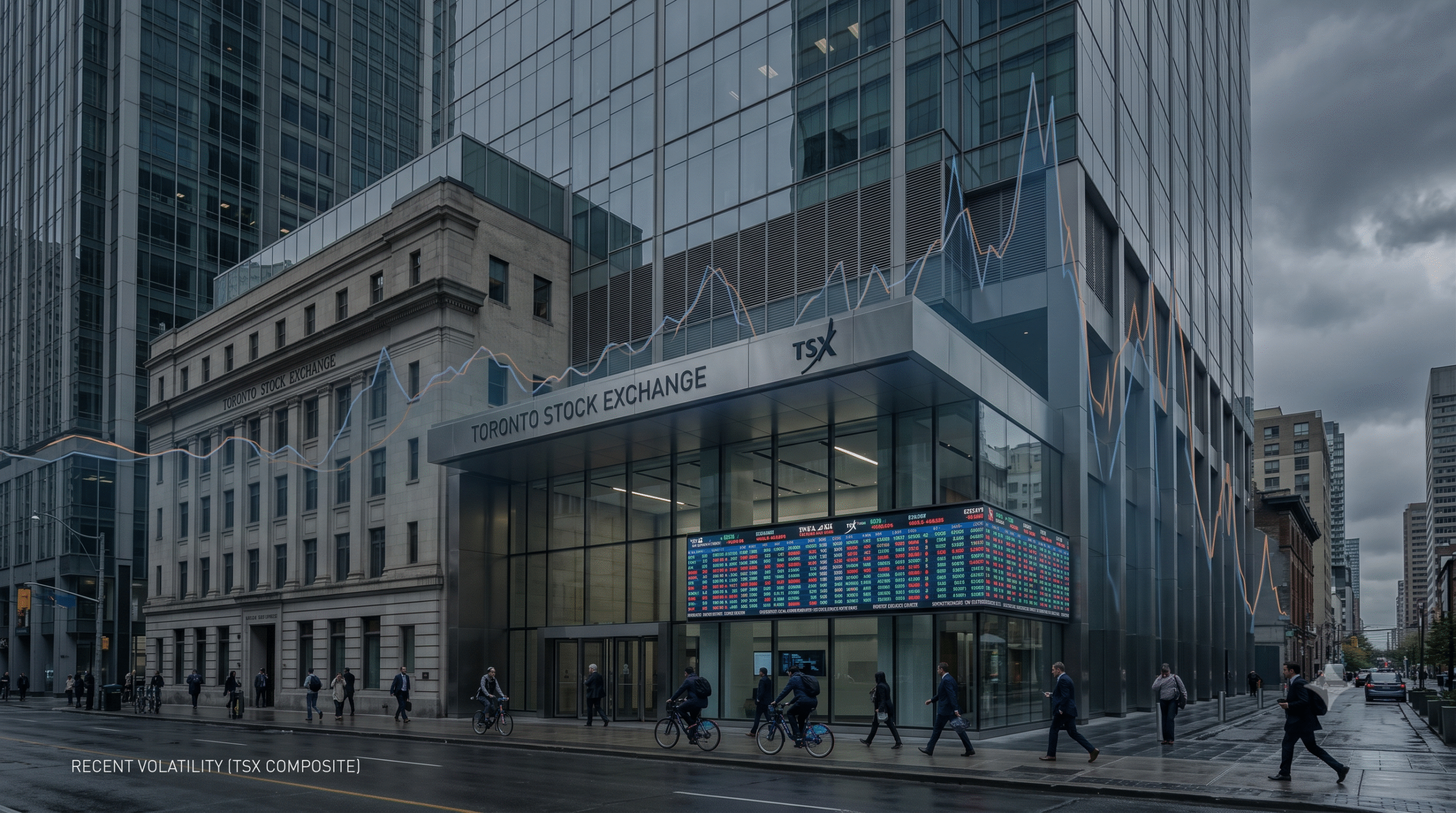
The S&P/TSX Composite Index has spent the past several sessions trading in a narrow band around the 35,000 level — a psychologically important threshold that has alternately acted as support and resistance as investors process a series of conflicting macro signals. The index’s one-year return stands at approximately 31%, an extraordinary run that has outpaced most developed-market peers, yet the forward picture is considerably more nuanced than that backward-looking gain suggests.
The TSX Composite has delivered a one-month return of approximately 1.32%, a three-month return of 9.55%, and a six-month return of 8.95%, against a 52-week range spanning from roughly 26,484 to 35,629. These figures illustrate both the strength of the recovery and the compressed room for further gains without fresh catalysts. The index’s structural composition — with financials, energy, and materials representing approximately 60 to 65 per cent of the total weight — means performance continues to be disproportionately influenced by commodity cycles and bank earnings rather than technology or consumer dynamics.
The Canadian stock market concluded a tumultuous trading session on June 23 with a cautious approach as risk aversion globally gained traction, with the TSX declining amid a sell-off by technology, mining, and energy sectors as traders grappled with interest rate uncertainties and the volatility of commodities, while there was some selective strength within the banking sector.
Also Read: Safe investments for new investors
What Happened
Three distinct developments shaped TSX dynamics through the most recent trading sessions. First, Canada’s May inflation report confirmed headline CPI at 3.2% year-over-year — above the Bank of Canada’s 1% to 3% target range for the first time in 29 months. This was the first time in nearly two and a half years that Canada’s headline inflation moved outside the Bank of Canada’s 1%–3% target range, at a time when rising living costs are emerging as a political challenge for Prime Minister Mark Carney. Second, US-Iran diplomatic talks progressed, leading to crude price softening that relieved pressure on energy-driven inflation but moderated the energy sector’s recent leadership. Third, Canada’s banking regulator lowered capital requirements for major lenders — the most investor-friendly development of the week for financials.
BMO’s chief economist Doug Porter described the May inflation number as a “mild disappointment overall,” noting it’s “never good news to see the overall inflation rate track above 3%, even if it is for one month only.”
Also Read: Stock investment Canada for beginners
Why It Matters
The Inflation Overshoot and Its Limits
The breach of the Bank of Canada’s upper target band is notable but, critically, not accompanied by broad-based core inflation pressure. Bank of Canada governor Tiff Macklem characterised the surge as mainly due to energy prices, with no sign of general inflation so far. Core inflation measures, which strip out food and energy, remain soft — a distinction that gives the Bank of Canada cover to maintain its 2.25% rate stance rather than pivot to tightening. This reading is constructive for rate-sensitive TSX sectors.
Capital Relief as a Catalyst
The regulatory decision to lower bank capital requirements represents a genuine positive for the financial sector and, by extension, for credit conditions in the broader economy. Freed capital at institutions like RBC, BMO, and their Big Six peers can support lending growth at a moment when Canadian households and businesses have been cautious about borrowing.
Sector Breakdown
The gold mining segment delivered meaningful volatility this week, with gold prices advancing and lifting Agnico Eagle by 2.2%, WPM by 4.7%, and Barrick by 1.2% in recent sessions. This followed a sharp correction earlier in the month. Gold had at its 2026 peak been trading well above US$4,200 per ounce, driven by a combination of geopolitical risk premium, central bank buying, and speculative demand. On the technology front, Shopify (TSX:SHOP) — Canada’s largest publicly traded company by market capitalisation — continues to function as the index’s primary growth technology bellwether, with its performance tracking closely with broader Nasdaq sentiment. Investors are watching whether Shopify can maintain its global merchant growth trajectory as AI-enhanced commerce tools become a more competitive market.
Risks to Watch
The key macro risks for TSX investors heading into mid-summer are interrelated. An accelerated oil price decline following a formal Iran peace deal could weigh on energy sector earnings and reduce TSX dividend capacity simultaneously. If June CPI data does not show a meaningful decline from May’s 3.2%, markets may begin pricing a risk of a Bank of Canada rate hike later in 2026, which would be a headwind for nearly all equity sectors. The Canadian dollar at approximately 0.70 USD also warrants monitoring — a weaker loonie amplifies commodity revenue when translated to Canadian dollars but adds import cost pressure.
What to Watch Next
The July 15 Bank of Canada rate announcement is the most important near-term event for TSX investors. June CPI, due in late July, will set the context for that decision. Q2 earnings season begins in earnest in late July and August, with Canadian bank results, energy company production updates, and Shopify’s commerce volume data all functioning as key signposts for the second half of 2026.
Also Read: Best long term Canadian stocks
Final Outlook
The TSX enters the final week of June in a state of conditional resilience. The structural strengths that have driven a strong year-to-date performance — oil sands cash generation, bank earnings quality, and gold’s geopolitical premium — remain broadly intact, but each carries a specific risk attached to diplomatic, regulatory, and inflation developments that are evolving in real time.
For investors, the current environment rewards a balanced approach: maintaining energy and financial exposure while ensuring positions are sized for a scenario of moderating commodity prices and steady-to-rising rates. The market is not broken, but it is asking harder questions than it was at the start of 2026.
Sign Up For our Newsletters to get latest updates