


Table of Contents
- Market Context
- What Happened
- Why It Matters
- Sector Breakdown
- Risks to Watch
- What to Watch Next
- Final Outlook
Market Context
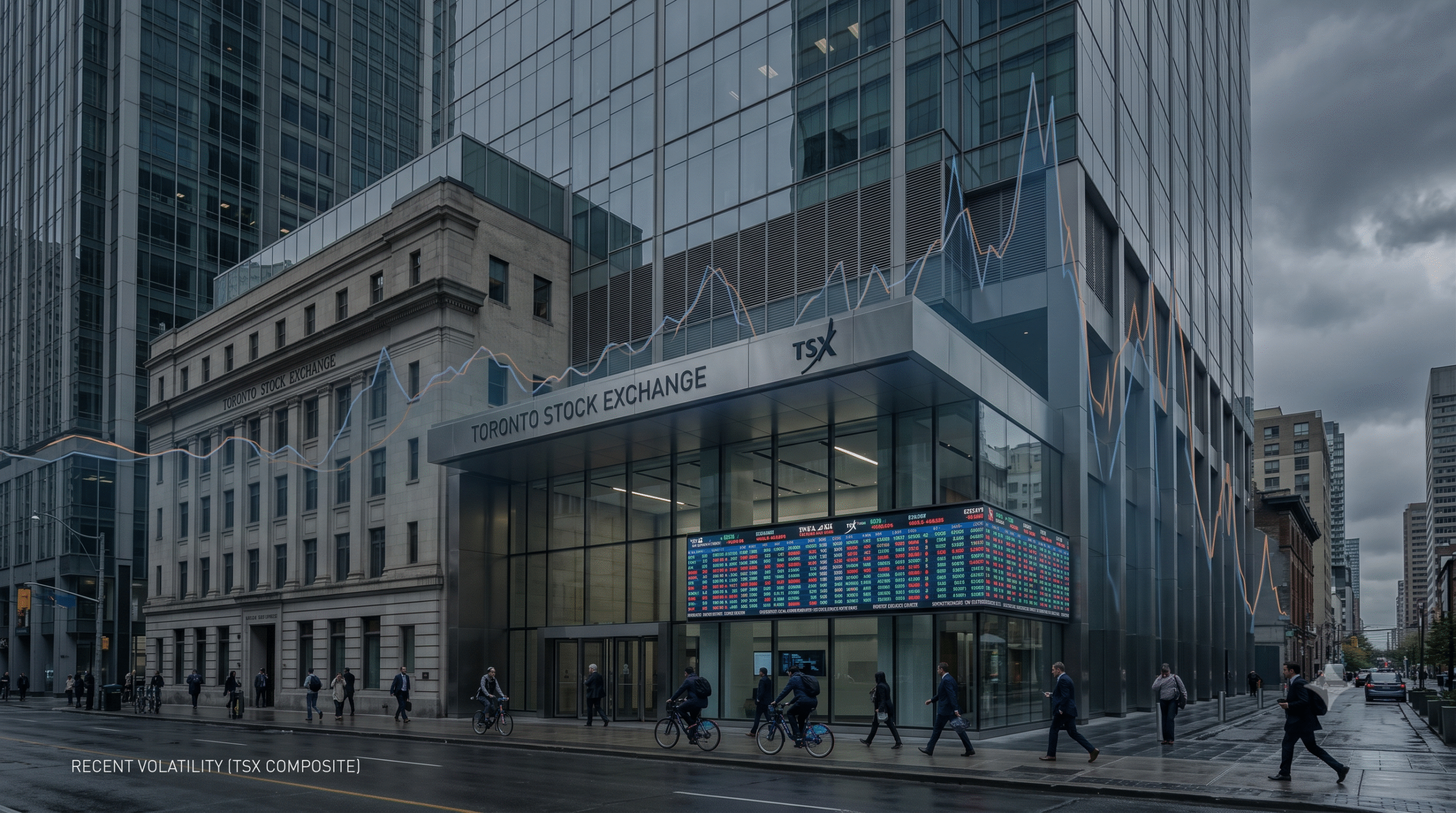
The S&P/TSX Composite Index has been navigating a choppy mid-June stretch, pulled in opposing directions by geopolitical developments, a cautious U.S. Federal Reserve, and a Bank of Canada that remains firmly on hold. Within that broader turbulence, the contrast between Canada’s leading technology commerce platform and its storied Class I freight railway has rarely been more instructive for investors trying to understand where value actually lives on the TSX right now.
On one side, there is a commerce technology company that has delivered exceptional operating metrics in 2026 — revenue surging, gross merchandise volume crossing record highs, and artificial intelligence reshaping its merchant ecosystem — yet the stock has been cut nearly in half from its 52-week peak. On the other, there is a freight railway that has set grain shipment records, signed major new industrial contracts, and trades close to where analysts estimate it is fairly valued, generating steady dividends along the way.
For investors evaluating where Canadian equities are heading into the second half of 2026, comparing these two names illuminates the broader debate between growth versus value, capital-light versus capital-intensive, and technology optimism versus industrial certainty. They are not competing investment ideas so much as they are opposing lenses on the same market.
Also Read: Best long term Canadian stocks
What Happened
Canada’s leading e-commerce platform closed at approximately CA$151.58 on June 19, down around 1.4% on the session, with a 52-week range stretching from CA$129 at the low to CA$253 at the high. Despite a stock price that has fallen sharply from its peak, the underlying business continues to expand at a formidable pace. The company reported first-quarter 2026 revenue growth of 34% year-over-year, with gross merchandise volume crossing $100 billion for the first time in a single quarter. Free cash flow came in at $476 million, representing a 15% margin. Management guided for second-quarter revenue growth in the high-twenties percentage range — a reading some investors interpreted as a deceleration signal, contributing to continued share price pressure.
The railway, by contrast, closed at approximately CA$159.73 on June 19, off a modest 0.42% on the day, sitting within a 52-week range of CA$126 to CA$170. In May, the company moved over 2.96 million metric tonnes of grain from Western Canada, surpassing its previous monthly record. In early June, it announced a transportation agreement with a major global mining company to support the movement of potash from Saskatchewan’s newest major mine — a long-duration contract that adds meaningful volume visibility. The railway’s second-quarter earnings announcement is expected in late July, and investors are watching whether these operational milestones translate into earnings-per-share improvement.
Why It Matters
Commerce at the Crossroads of AI
The e-commerce platform’s most significant strategic development in 2026 has been its positioning at the centre of artificial intelligence-driven commerce. The company has built integrations that allow shoppers to discover and purchase from its merchant base through AI-powered tools operated by some of the world’s largest technology companies. In the first quarter, AI-driven traffic to merchant stores reportedly jumped roughly eight times year-over-year, and orders completed through AI-powered search increased nearly thirteen times. The board also authorised an additional $3 billion in share repurchases during the period — a signal of management’s confidence in the long-term value of the platform even as the market remains sceptical.
Rail’s Structural Freight Advantage
The railway’s story is quieter but no less compelling in its own right. A combination of record agricultural exports, expanding potash volumes from new Saskatchewan mines, and propane export records along its western corridors reflects the structural advantage of owning a continental freight network that cannot be replicated. The railway generated approximately CA$17.7 billion in revenue in 2025 across a diversified freight mix that includes intermodal containers, petroleum and chemicals, grain and fertilisers, forest products, and metals — a breadth of cargo that provides natural insulation against any single commodity cycle.
Sector Breakdown
The e-commerce platform sits in the TSX’s technology sector and carries a premium valuation by any standard measure. Its trailing price-to-earnings ratio is approximately 105 times, with a beta of around 2.59 — meaning the stock amplifies broader market volatility significantly in both directions. Analyst consensus price targets suggest meaningful upside from current levels if the growth story remains intact, but the path is not linear.
The railway, by contrast, trades at a trailing P/E of approximately 21 times — a modest premium to the broader industrial sector that reflects its network monopoly characteristics and consistent earnings generation. Its dividend yield sits near 2.22%, and market capitalisation approaches $97 billion, making it one of the largest companies on the TSX. The railway has a beta near 1.0, meaning it broadly tracks the market without amplifying it — a desirable quality in volatile periods.
The two companies require meaningfully different investor temperaments. One is paying for a dominant future in AI-enabled commerce. The other is being paid a dividend to own North America’s most strategically positioned freight network. Neither approach is wrong — they simply reflect different definitions of value and different tolerances for volatility.
Also Read: Best long term Canadian stocks
Risks to Watch
For the commerce platform, the central risk is the premium valuation sitting atop a growth rate that is, by definition, slowing from its peak. Margin compression — from 22.7% net profit margin in the first quarter of 2025 to approximately 10.7% in the first quarter of 2026 — has raised questions about the sustainability of profitability as the company invests heavily in AI infrastructure and merchant tooling. A platform migration deadline at month-end adds near-term operational uncertainty, as merchants must complete technical transitions or risk disruption. Legal and regulatory scrutiny in multiple jurisdictions adds further headline risk.
For the railway, the primary risks are fuel cost volatility, regulatory exposure on grain pricing, labour relations, and the potential for a softening agricultural outlook to reduce Western Canada volumes. Any diplomatic resolution in the Middle East that leads to lower global oil prices could also reduce the petroleum and chemicals freight that contributes meaningfully to the railway’s revenue mix.
What to Watch Next
Investors focused on the commerce platform should mark August 5 as the key date, when second-quarter results will confirm or deny whether the growth deceleration implied in guidance materialises. For the railway, the late-July earnings call will offer a first look at whether record grain tonnage and new potash agreements have translated into improved earnings-per-share and whether management reaffirms its full-year outlook.
More broadly, investors should monitor the Canadian dollar — its continued weakness against the U.S. dollar affects the competitive dynamics of both companies’ North American operations — and U.S. Federal Reserve commentary, which continues to shape the discount rates applied to growth-oriented technology names like the commerce platform.
Also Read: Best long term Canadian stocks
Final Outlook
These two companies represent genuinely different propositions for genuinely different investors. The commerce platform is a growth machine that the market is currently re-rating lower on valuation discipline — not on any evidence that the business is deteriorating. The railway is a steady compounder offering income and operational resilience while freight fundamentals remain constructive.
Investors with a growth orientation and a long time horizon may find the current pullback in the technology name worth examining carefully. Those seeking ballast in a volatile macro environment may prefer the railway’s yield and freight visibility. What neither stock warrants is a blind commitment without a clear entry framework and an honest appraisal of the specific risks each carries.
Sign Up For our Newsletters to get latest updates