


Table of Contents
- Market Context
- What Happened
- Why It Matters
- Sector Breakdown
- Risks to Watch
- What to Watch Next
- Final Outlook
Market Context
Canada’s economic backdrop shifted meaningfully more constructive this week after the United States and Iran paused hostilities over the weekend, easing weeks of oil-driven inflation concerns that had complicated the outlook for both monetary policy and broader market sentiment.
What Happened
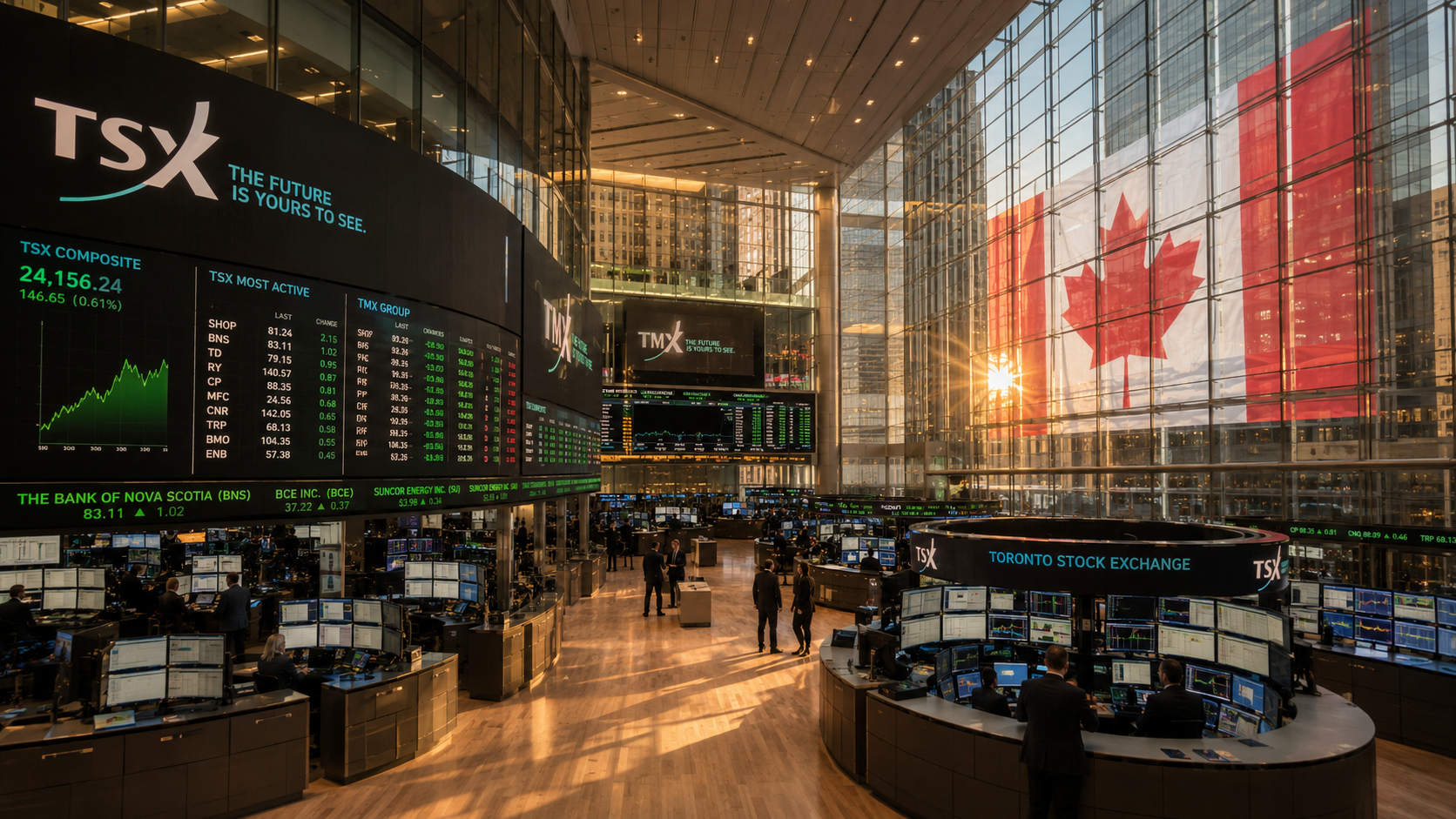
Crude oil prices fell sharply Monday after the U.S. and Iran halted strikes against each other over the weekend amid renewed diplomatic efforts, with President Trump reportedly open to restarting peace talks. The decline in oil prices eased energy-driven inflation concerns and pushed Canadian bond yields lower, a shift that rippled across multiple parts of the market. Financials benefited directly, with RBC, BMO, and CIBC each gaining roughly 1% and Brookfield advancing 1.1%, while gold prices rose as lower U.S. Treasury yields boosted demand for the metal, lifting mining stocks including Agnico Eagle, Barrick, and Wheaton Precious Metals. The broader S&P/TSX Composite reflected this shift, gaining 0.56% to close at a fresh record high of 35,568.14, with gains led by information technology, consumer discretionary, and consumer staples sectors. Energy shares moved in the opposite direction, with Suncor and Cenovus each losing close to 3% as lower oil prices weighed directly on producer cash flow expectations.
Why It Matters
Falling oil-driven inflation pressure gives policymakers meaningfully more flexibility than they had just a week ago. With energy prices no longer feeding as directly into broader inflation expectations, both the Bank of Canada and Federal Reserve may find themselves with a clearer path forward, assuming this weekend’s ceasefire pause proves durable rather than temporary.
The broad-based rally across financials, technology, and gold, occurring simultaneously with energy sector weakness, illustrates how directly this week’s market moves are tied to a single underlying story. Nearly every major sector move Monday can be traced back to the same catalyst: falling oil prices easing inflation concerns and pushing bond yields lower, a reminder of how dominant this geopolitical story has become for broader market direction.
Also Read: Top Canadian tech AI stocks
Sector Breakdown
On monetary policy, this week’s easing of oil-driven inflation pressure could provide both the Bank of Canada and Federal Reserve with additional room to maintain a steadier policy stance, following weeks in which elevated energy prices had complicated that calculus. On bond markets, falling Canadian yields Monday directly supported both financials and gold miners, two sectors that had faced relative pressure during the recent period of rising rates. On corporate earnings, strong results from both Celestica and Gibson Energy, reported the same day as this broader market shift, suggest underlying corporate fundamentals remain solid even as macro conditions evolve quickly.
Risks to Watch
The most significant risk is that this weekend’s ceasefire pause proves temporary, a pattern that has repeated multiple times throughout this conflict, which would likely reverse both the oil price decline and the broader rally it triggered across financials and gold miners. A renewed spike in oil prices would also revive the same inflation concerns that had complicated central bank policy in recent weeks. Energy sector weakness, if sustained, could also weigh on overall Canadian economic activity given the sector’s substantial contribution to national output.
What to Watch Next
Investors should watch closely for confirmation of whether this weekend’s pause in U.S.-Iran hostilities holds through the week, given its outsized influence on Monday’s broad market moves. Continued bond yield trends will be important for gauging how durable this week’s shift toward easier financial conditions proves to be. Any further central bank commentary reflecting this week’s easing of oil-driven inflation pressure will also be worth monitoring in the days ahead.
Final Outlook
This week’s ceasefire pause has meaningfully improved Canada’s broader economic and market backdrop, easing inflation pressure and supporting a fresh record high on the TSX, even as the underlying situation remains fluid and only partially resolved. Investors should treat this improvement as genuinely encouraging while recognizing how quickly sentiment has reversed at multiple points throughout this conflict.
Verdict: Cautiously constructive, with continued ceasefire durability as the key factor shaping the outlook from here.
Sign Up For our Newsletters to get latest updates