


Table of Contents
- Market Context
- What Happened
- Why It Matters
- Sector Breakdown
- Risks to Watch
- What to Watch Next
- Final Outlook
Market Context
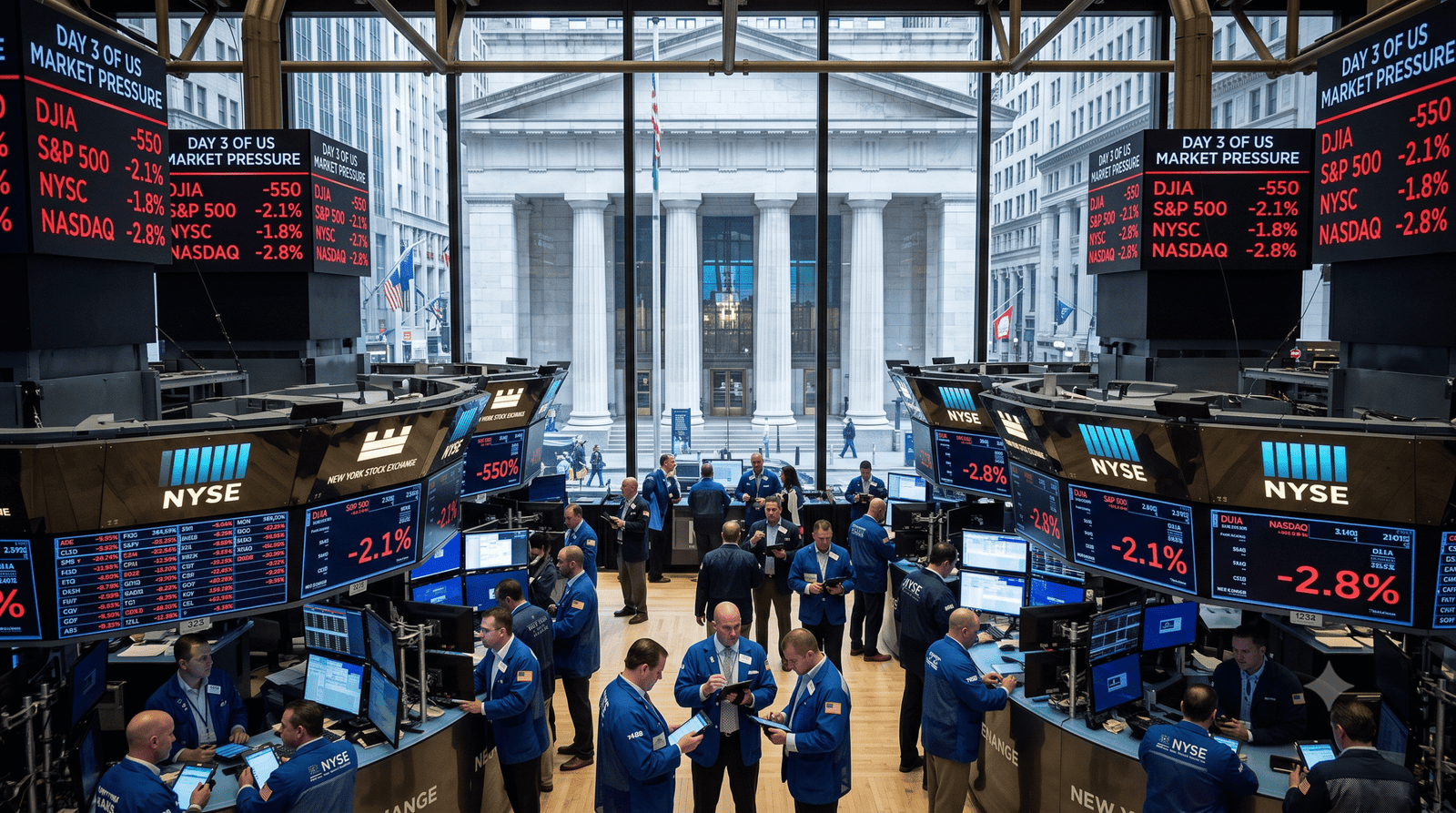
U.S. equity markets are navigating what Charles Schwab’s market strategists characterised as an “unfavorable pairing” — rising oil prices and rising interest rates arriving simultaneously. On September 9, Brent crude surged 3.4% to US$101.21 per barrel and the U.S. 10-year Treasury yield climbed to 4.84%, its highest level since 2023. Wall Street fell for a third consecutive session: the Dow Jones Industrial Average dropped 0.77% to 52,381, the S&P 500 shed 0.48% to 7,636, and the Nasdaq Composite fell 0.64% to 26,253. The Russell 2000 — the small-cap index most sensitive to domestic economic conditions — fell 1.30%, the session’s steepest decline among major benchmarks and a signal that investors are becoming concerned about the growth implications of sustained high energy costs. The VIX rose 4.58% to 16.44 — elevated but not yet at the levels associated with systemic fear.
For Canadian investors with U.S. equity exposure through cross-listed ETFs, U.S.-listed stocks, or direct holdings, these three sessions of declines carry specific implications. The S&P 500’s 12.1% year-to-date gain through September 8 has been driven substantially by AI-related technology performance — with S&P 500 ETFs returning approximately 17.6% and QQQ/VGT adding more than 21% on technology concentration. The current headwinds — oil above US$100 raising inflation expectations, Treasury yields at 4.84% raising discount rates, and the Canada-U.S. trade war escalating with new tariff proclamations — are all simultaneously compressing the premium that investors were willing to pay for growth-oriented equities. The gap between the S&P 500’s 17.6% ETF return and the index’s current momentum is the most visible expression of that compression.
The week’s most unusual juxtaposition involved Apple’s product launch on September 9 — the company’s fall event reportedly introduced a folding iPhone and a touch-screen MacBook — yet Apple’s stock still finished lower on the day. That “sell the event” outcome, in which a major product announcement fails to support a stock that had arguably already priced in the innovation, is symptomatic of a market environment where macro headwinds are overriding company-specific positive catalysts.
What Happened
On September 9, U.S. stocks fell for a third consecutive session as the persistent rise in oil prices and Treasury yields continued to rattle investors. Brent crude crossed US$100 per barrel — surging to US$101.21 — following further overnight strikes in the Persian Gulf and CENTCOM’s confirmation of destroyed Iranian crude carriers. WTI rose to approximately US$96.05. The U.S. 10-year yield hit 4.84% after the Treasury’s US$6 billion buyback of 10–20 year bonds failed to contain the rise — a signal that structural inflation concern is larger than tactical intervention can address. JJ Kinahan, senior vice president at Cboe Global Markets, described the combination explicitly: “Fears of rising interest rates coupled with escalating crude oil prices is never a great combination for the stock market.” In technology, Meta launched Muse — its new AI assistant — which provided a positive catalyst for Meta shares. Marvell moved higher after lifting its revenue targets. Apple held its fall product event reportedly featuring a folding iPhone and touch-screen MacBook, but the stock still finished lower. Trump signed new tariff proclamations adding Canadian goods to restricted lists, with 50% tariffs on a broader range of Canadian goods effective September 29 — a bilateral trade escalation that adds Canada-U.S. tension as an additional risk layer to the already complex macro environment.
Why It Matters
The 4.84% 10-Year Yield Is the U.S. Market’s Most Important Single Number This Week
The U.S. 10-year Treasury yield at 4.84% — its highest since November 2023 — is not just a bond market statistic. It is the discount rate that investors apply to every equity valuation model on Wall Street, and its current level is creating simultaneous compression across multiple equity categories. Long-duration technology growth stocks — which were pricing future earnings streams at lower discount rates — face immediate valuation headwinds. Dividend-yielding equities face increased competition from Treasury yields for income-focused investor capital. Real estate investment trusts — which use long-term debt for property financing — face both higher borrowing costs and valuation compression. The fact that the yield reached 4.84% despite the Treasury Department tripling its buyback programme to US$6 billion signals that the market’s inflation expectations are driving yields more powerfully than tactical Treasury operations can counteract.
Apple’s “Sell the Event” Outcome Signals Market Regime Change
When Apple holds its signature fall product launch — introducing what appears to be its first folding iPhone — and the stock still closes lower, it signals something important about the current market regime: macro headwinds are overriding company-specific positive catalysts with greater force than in previous years. In a different rate and oil environment, Apple’s folding iPhone would likely have driven meaningful upside on launch day. In the current environment — 4.84% 10-year yields, oil at US$96 WTI, and three consecutive sessions of index declines — investors appear to be taking any positive catalyst as an opportunity to reduce risk exposure rather than add to it. That behavioural shift, if sustained, has implications for every company-specific catalyst through Q4 2026.
Sector Breakdown
The U.S. market sector picture on September 9 mirrors Tuesday’s with remarkable consistency. Energy was the standout positive performer — gaining more than 1% — as the direct commodity price beneficiary of Brent’s US$100 breach. Technology was among the weakest performers despite Apple’s product event and Meta’s Muse launch, as the rate sensitivity of growth multiples dominated company-specific positive news. Industrials and consumer discretionary faced headwinds from rising energy costs and the Canada-U.S. trade war escalation’s supply chain implications. Small caps — Russell 2000 down 1.30% — bore the steepest proportional losses, reflecting their higher sensitivity to domestic borrowing costs and energy input expenses relative to the large-cap names that dominate the S&P 500. Defensive sectors — utilities, consumer staples — performed relatively better, consistent with the risk-reduction posture that Kinahan characterised as investors “moving into defensive mode.”
Risks to Watch
Thursday’s August U.S. CPI release is the most consequential single data point remaining before the September 15–16 FOMC meeting. An inflation reading that confirms the energy price surge is broadening into core CPI would move the September hike probability from the current approximate 56% toward 70%+ and trigger another round of equity multiple compression. The ECB rate hike — also expected Thursday — will provide the global context for whether Wednesday’s yield increases were a North American-specific event or part of a globally coordinated tightening that affects all equity markets simultaneously. The September 29 effective date for Trump’s new Canadian tariff proclamations — including 50% duties on a broader range of Canadian goods — creates a 19-day countdown to a further trade war escalation that will affect U.S. companies with Canadian supply chains.
Also Read: Top Canadian tech AI stocks
What to Watch Next
Thursday’s U.S. August CPI (8:30 a.m. ET) is the week’s defining data release. The ECB decision and press conference will provide European monetary policy context. Friday’s U.S. August PPI provides a secondary inflation signal. The September 16 FOMC decision will resolve the hike question. Investors should watch whether the 10-year yield sustains above 4.84% or whether Thursday’s CPI provides a catalyst for a yield retreat that would allow risk assets to stabilise. Apple’s stock price action following the folding iPhone launch will be a signal of whether the “sell the event” dynamic is temporary or sustained.
Final Outlook
U.S. markets on September 10 are navigating a genuinely difficult three-variable stress test: oil above US$100, Treasury yields at 4.84%, and a Canada-U.S. trade war escalating with each passing day. The three consecutive sessions of declines — Dow, S&P 500, Nasdaq, and Russell 2000 all falling — are the market’s rational response to an unfavourable combination that has historically produced volatility even when underlying corporate earnings are strong. Apple’s fall event failing to lift the stock is the session’s most telling signal: macro headwinds are currently stronger than individual company catalysts.
The S&P 500’s 12.1% year-to-date gain provides a cushion against which the current three-session decline represents a manageable pullback rather than a structural breakdown. Thursday’s CPI will determine whether that cushion shrinks further or begins to rebuild.
Verdict: Neutral on U.S. equities heading into Thursday’s CPI. Energy sector exposure is the clearest near-term U.S. equity conviction within the current macro regime. Technology names face multiple compression pressure that will persist until bond yields stabilise. Small caps are the most rate-sensitive category and should be approached with caution until the September 16 FOMC provides resolution.
Sign Up For our Newsletters to get latest updates