


Table of Contents
- Market Context
- What Happened
- Why It Matters
- Sector Breakdown
- Risks to Watch
- What to Watch Next
- Final Outlook
Market Context
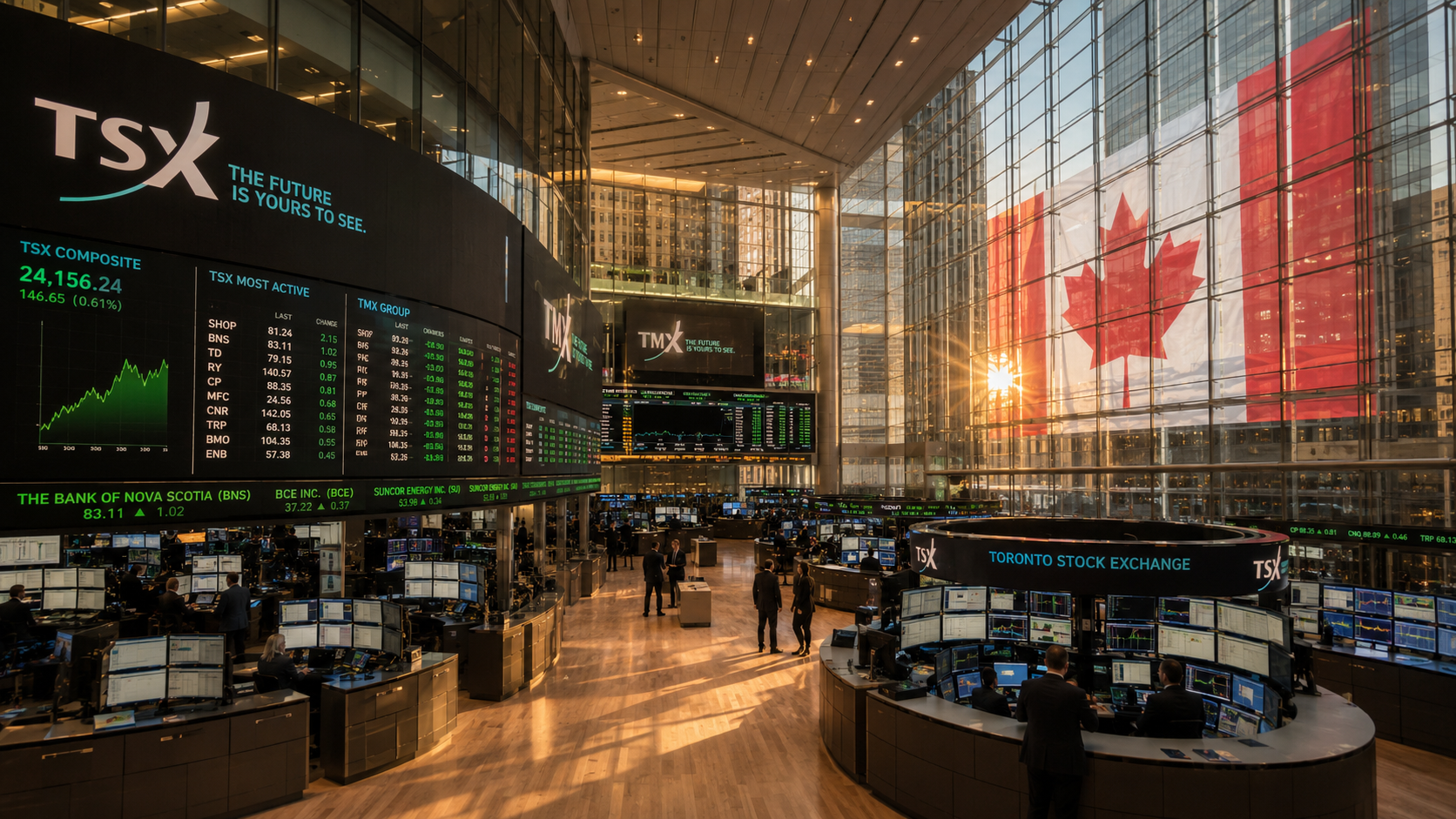
The stocks that attract the highest daily trading volumes on the TSX are not random — they reflect the investment themes that institutional and retail investors are most actively engaging with, managing, and positioning around on any given day. Through October’s first week, the five most actively traded TSX names have consistently included Canadian Natural Resources (TSX:CNQ), Suncor Energy (TSX:SU), Enbridge (TSX:ENB), and the major Canadian bank stocks — a composition that encapsulates the TSX’s foundational dual identity as a resource-and-income market. Kalkine Media’s October 7 analysis confirms that both CNQ and ENB are specifically “in focus” today, with articles titled “Why Is Canadian Natural (TSX:CNQ) in Focus Amid Its Long-Life Production Story?” and “Why Is Enbridge (TSX:ENB) in Focus Amid Its Pipeline Cash Flow Story?” published simultaneously — a co-occurrence that is not coincidental.
CNQ’s continued high-volume trading status through the first week of October reflects the oil market’s ongoing Iran conflict uncertainty — with Trump having rejected Iran’s Hormuz proposal on September 28, keeping supply disruption risk elevated and Canadian oil sands production revenues above pre-conflict baselines — alongside the company’s specific dividend investment case. Simply Wall St’s October 2026 Dividend Powerhouse analysis confirmed CNQ as the lead recommendation, with a market capitalisation of approximately CA$142.4 billion, 26 consecutive years of dividend increases, and characterisation as “undervalued with solid track record and pays a dividend.” That combination of institutional market cap, dividend growth record, and valuation argument drives the sustained institutional volume that makes CNQ consistently one of the TSX’s most traded names.
Enbridge (TSX:ENB) adds a different dimension to the most-traded list. Where CNQ’s volume reflects commodity-linked income and production thesis activity, Enbridge’s volume reflects the regulated infrastructure income story that a different cohort of institutional investors — pension funds, insurance companies, infrastructure funds — is continuously managing. Enbridge’s approximately 5.8 million barrels per day of throughput capacity and its 32-year consecutive dividend growth streak generate the kind of predictable, regulated cash flow that requires constant institutional portfolio rebalancing around each dividend declaration and ex-date cycle.
What Happened
On October 7, Kalkine Media published simultaneous analysis pieces on both Canadian Natural Resources (TSX:CNQ) and Enbridge (TSX:ENB), placing both in the day’s financial sector spotlight. Kalkine’s CNQ analysis — “Why Is Canadian Natural (TSX:CNQ) in Focus Amid Its Long-Life Production Story?” — highlights the company’s multi-decade oil sands reserve life, its record production trajectory of approximately 1.6 million boe/d in Q1 2026, and its 26-year consecutive dividend increase record as the anchoring elements of the current institutional attention. Kalkine’s Enbridge analysis — “Why Is Enbridge (TSX:ENB) in Focus Amid Its Pipeline Cash Flow Story?” — focuses on Enbridge’s regulated pipeline throughput revenues, its CA$40 billion secured capital programme, and its 5.1% current dividend yield as the elements driving institutional pipeline infrastructure positioning. On the banking side, RBC rose 0.58% to CA$279.21 and was simultaneously highlighted by Kalkine’s “Can the Capital Strength Story Keep RBC (TSX:RY) in the Financial Stocks Spotlight?” — another simultaneous institutional media focus that confirms the bank’s current momentum.
Why It Matters
Simultaneous Institutional Coverage of CNQ, ENB, and RBC Signals Coordinated Thematic Positioning
The co-occurrence of simultaneous Kalkine Media institutional analysis on CNQ, Enbridge, and RBC on October 7 is not simply editorial coincidence — it reflects a coordinated thematic positioning event where institutional research platforms are simultaneously drawing investor attention to the same category of investment story: Canadian dividend-growth income machines with long track records, institutional-scale market capitalisation, and defensible earnings quality in a complex macro environment. That simultaneous coverage drives correlated trading volume across all three names as investors who follow institutional research platforms simultaneously evaluate the same positioning arguments. Understanding this mechanism helps explain why the TSX’s most-traded names cluster around a small number of quality narratives rather than spreading uniformly across all 1,500+ listed companies.
The “Long-Life Production” and “Pipeline Cash Flow” Frames Are October’s Most Defensible Investment Narratives
CNQ’s “long-life production story” — anchored by multi-decade oil sands reserve life that ensures production continuity through any commodity cycle — and Enbridge’s “pipeline cash flow story” — anchored by regulated, throughput-based revenues that are independent of commodity prices — represent the two most defensible investment narratives available in October’s macro environment. With FOMC hike probability at 20% and oil prices above US$80 from the Iran conflict, both narratives are being simultaneously validated by the current market conditions. That dual validation — income sustainability from dividend records, and revenue stability from operational structure — creates the institutional demand that generates sustained high trading volumes.
Sector Breakdown
The TSX’s most-traded names cluster across three investment themes that have dominated October’s opening week. Energy income and production — CNQ and Suncor — attract the highest volumes because the Iran conflict’s oil price support and the dividend growth records create a large, active institutional ownership base that is continuously rebalancing around monthly price movements, dividend ex-dates, and commodity data. Pipeline infrastructure income — Enbridge and TC Energy — attracts a separate but equally active institutional base that is specifically positioned for regulated long-duration income streams. Banking income and capital appreciation — RBC, TD, BMO, and the broader Big Six — completes the volume picture as the largest single-category institutional holding in Canada. Together, these three clusters represent the TSX’s fundamental composition as a resource-and-income market that generates its highest volumes from the intersection of income stability, production growth, and commodity exposure.
Risks to Watch
For CNQ, the primary volume-driving risk is oil price direction — specifically any U.S.-Iran diplomatic breakthrough that removes the supply-disruption premium and pushes WTI toward US$75–80 from current elevated levels. That scenario would not challenge CNQ’s fundamental earnings sustainability — the company is profitable above US$65 WTI — but it would reduce the commodity income windfall that has been driving extraordinary free cash flow and buyback capacity. For Enbridge, global bond yield movements — which can occur independently of FOMC decisions, as early October demonstrated — remain the primary valuation headwind, since Enbridge’s regulated income multiple is directly sensitive to the bond yields that compete with its 5.1% dividend yield. For RBC, the proximity to analyst consensus price targets means near-term volume may be driven more by profit-taking than by fresh accumulation.
Also Read: Safe investments for new investors
What to Watch Next
CNQ’s Q3 earnings — expected in October — will be the most important company-specific catalyst for the energy sector’s most-traded name. Enbridge’s next capital programme milestone announcement — specifically any update on the B.C. coast pipeline that Carney and Smith announced earlier in 2026 — will be the long-duration infrastructure catalyst. RBC’s November Q4 fiscal earnings will be the most significant bank sector reporting event of the autumn. U.S. October CPI will determine whether the 20% FOMC hike probability holds or rebuilds toward 50% — the single most important variable for the TSX’s most-traded financial and infrastructure income names.
Final Outlook
The TSX’s most actively traded names — CNQ, Suncor, Enbridge, and the major banks — reflect a market in which the highest institutional attention is directed toward three intersecting themes: energy income, pipeline infrastructure income, and banking income. October 7’s simultaneous Kalkine Media institutional coverage of CNQ, Enbridge, and RBC confirms that these narratives are being actively monitored and positioned around by the institutional research community that drives TSX volume.
Verdict: Cautiously constructive on the TSX’s most-traded income and production names. CNQ’s long-life production story and Enbridge’s pipeline cash flow story are October’s most institutionally validated dividend investment cases. RBC’s capital strength story is the most analytically endorsed banking position. Position additions should account for proximity to analyst consensus targets and the October 28 BoC decision as the month’s key domestic policy event.
Sign Up For our Newsletters to get latest updates