

Unlock Premium Articles for Exclusive Insights!
You are reading a free article. Enter your details to unlock full access.
By submitting your details to unlock full access.
What Happened
The session’s key events were clustered around earnings and commodity price movements. Imperial Oil fell approximately 4% after its quarterly results, making it one of the day’s most notable single-stock decliners despite beating the earnings-per-share estimate at CA$1.94. Canadian Natural Resources lost 1.48%, Suncor was down approximately 1.5%, and TC Energy retreated more than 1% following earnings below expectations. On the financial side, Fairfax Financial slumped 7.5% after missing estimates — the largest single-session decline for a major financial name in the session.
Offsetting some of the pressure, Shopify rebounded 5.22% to CA$173.48, Celestica gained 2.12%, and CIBC and Bank of Nova Scotia closed modestly positive. Air Canada (TSX:AC) fell 2.09% to CA$18.26 after abandoning its 2026 guidance — drawing significant investor attention and finishing among the most actively traded names on the exchange. Crude oil’s retreat from above US$126 to settle near US$101.94 was the key macro driver for the energy-heavy index.

Why It Matters
The Energy-TSX Correlation Remains Alive
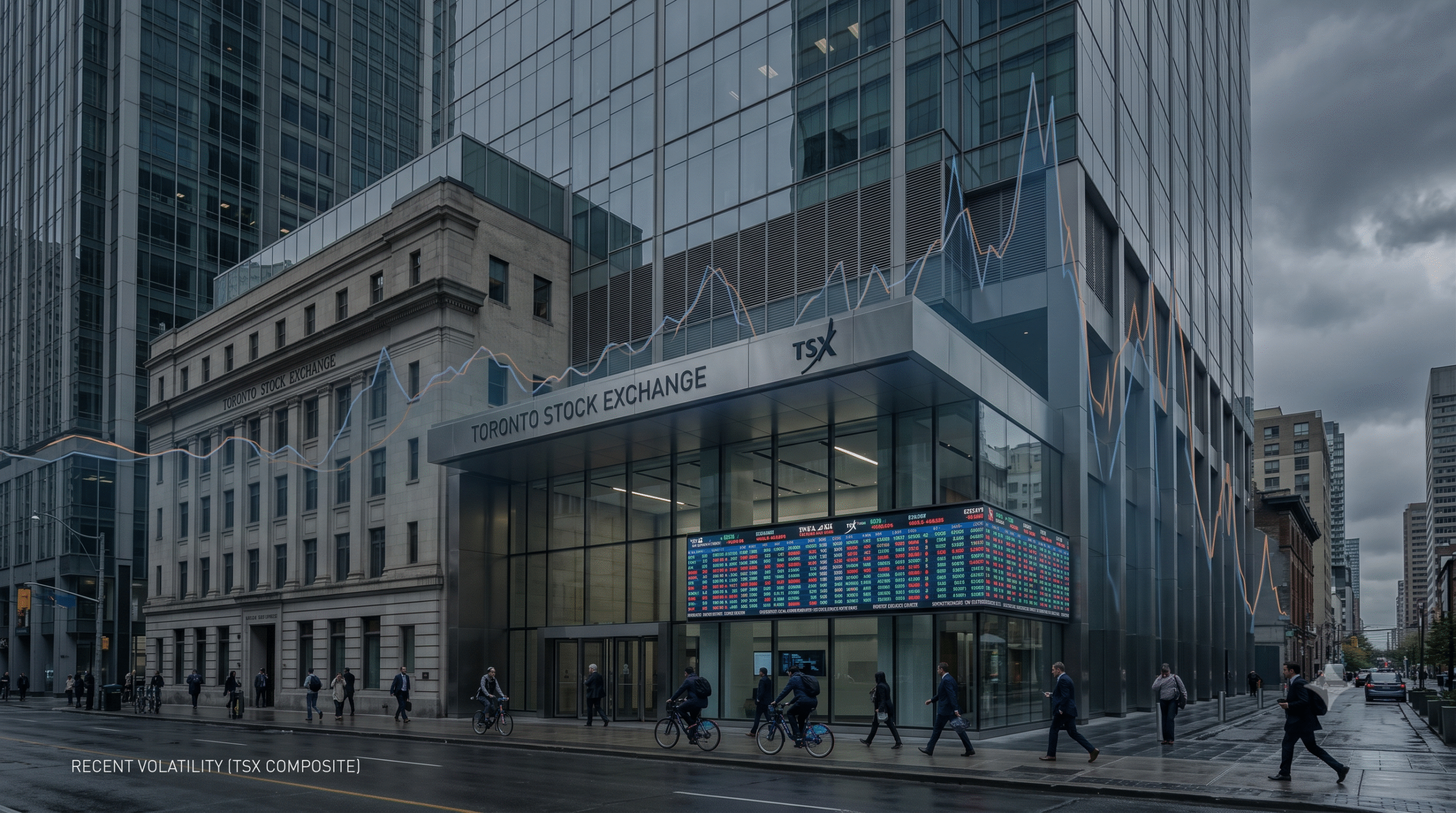
Canada’s stock market is more sensitive to oil prices than virtually any other major developed-market index. When WTI retreats — even from an artificially geopolitics-driven peak — the TSX feels it disproportionately. The May 1 session was a clear demonstration: while U.S. indices absorbed the same oil pullback and largely moved higher on earnings momentum, the TSX could not offset energy weakness with sufficient breadth elsewhere. This is a structural feature of the index that investors need to account for in their risk models.
GDP Data Sets a Cautious Tone for Banks
The domestic GDP flash estimate showing 0.4% Q1 growth with a flat March reading is not a recession signal, but it is a caution flag for bank investors. Canadian bank revenue streams — particularly from retail lending and mortgage origination — are sensitive to consumer spending confidence. A softer GDP backdrop, combined with the Bank of Canada’s hold and its implicit warning about potential rate hikes if oil stays elevated, creates a less certain environment for net interest margin expansion.
Sector Breakdown
Energy was the clear underperformer. The sector’s biggest names — CNQ, Suncor, Imperial Oil, and TC Energy — were all in negative territory by the close. The USDCAD exchange rate sat near 1.3587, meaning the Canadian dollar was trading at approximately 73.6 U.S. cents — a level that does not provide material export revenue relief for energy companies priced in U.S. dollars when oil prices themselves are falling.
Financials were mixed but weighted to the downside, with Fairfax Financial’s 7.5% decline the most dramatic event. Among the Big Six banks, the picture was nuanced: BMO, CIBC, and BNS managed small gains, while TD, RBC, and others ended flat to marginally negative. Technology was the one sector providing meaningful positive traction — Shopify’s 5.22% gain and Celestica’s solid advance gave the index some cushion.
Canadian bond markets reflected the cautious tone. The 10-year Government of Canada yield sits at 3.528%, down modestly in the session, suggesting that fixed-income investors are not panicking about inflation — a nuance worth noting given the Bank of Canada’s warning about potential rate hikes if oil stays elevated.
Risks to Watch
The TSX faces a near-term convergence of risks. Oil price volatility tied to Iran-U.S. geopolitics could swing the index 1–2% in either direction on a single day. Earnings season is not yet complete, and further guidance withdrawals — like Air Canada’s — could spook the market if they are perceived as signalling a broader economic softening. The TSX’s 35% year-over-year gain has compressed valuations relative to history, leaving less cushion for disappointment.
Externally, the U.S. dollar’s modest strengthening and elevated U.S. 10-year yields (4.379%) remain headwinds for commodity prices and therefore for the TSX’s resource-heavy composition.
What to Watch Next
The week of May 4 brings several important inputs for Canadian investors. The Bank of Canada’s June 10 rate meeting is approaching, and any data in the intervening weeks — particularly April CPI — will shape market expectations. U.S. employment data (non-farm payrolls) due imminently could influence the U.S. Federal Reserve’s posture and, by extension, the Canadian dollar and commodity markets. Remaining TSX earnings releases — particularly from banks reporting in the coming weeks — will either confirm or challenge the cautious consumer spending narrative embedded in the GDP data.
Also Read: Long term investing in Canada
Final Outlook
The TSX’s May 1 session was a reminder that Canada’s index remains a resource-and-finance story at its core, and that when both those pillars face simultaneous headwinds, the broader market struggles to move higher even when pockets of the market perform well. The 35% year-over-year run has been exceptional, and some consolidation around current levels is a reasonable base case as the market processes earnings, digests the BoC’s nuanced hold, and awaits clarity on oil prices.
Also Read: Stock investment Canada for beginners
For investors, the current TSX environment rewards active management over passive index exposure. Defensive positioning within quality financials, gold miners, and technology — alongside reduced exposure to oil producers at elevated valuations — may offer a more balanced risk profile heading into the summer months.
Sign Up For our Newsletters to get latest updates