

Table of Contents
- Market Context
- What Happened
- Why It Matters
- Sector Breakdown
- Risks to Watch
- What to Watch Next
- Final Outlook
Market Context
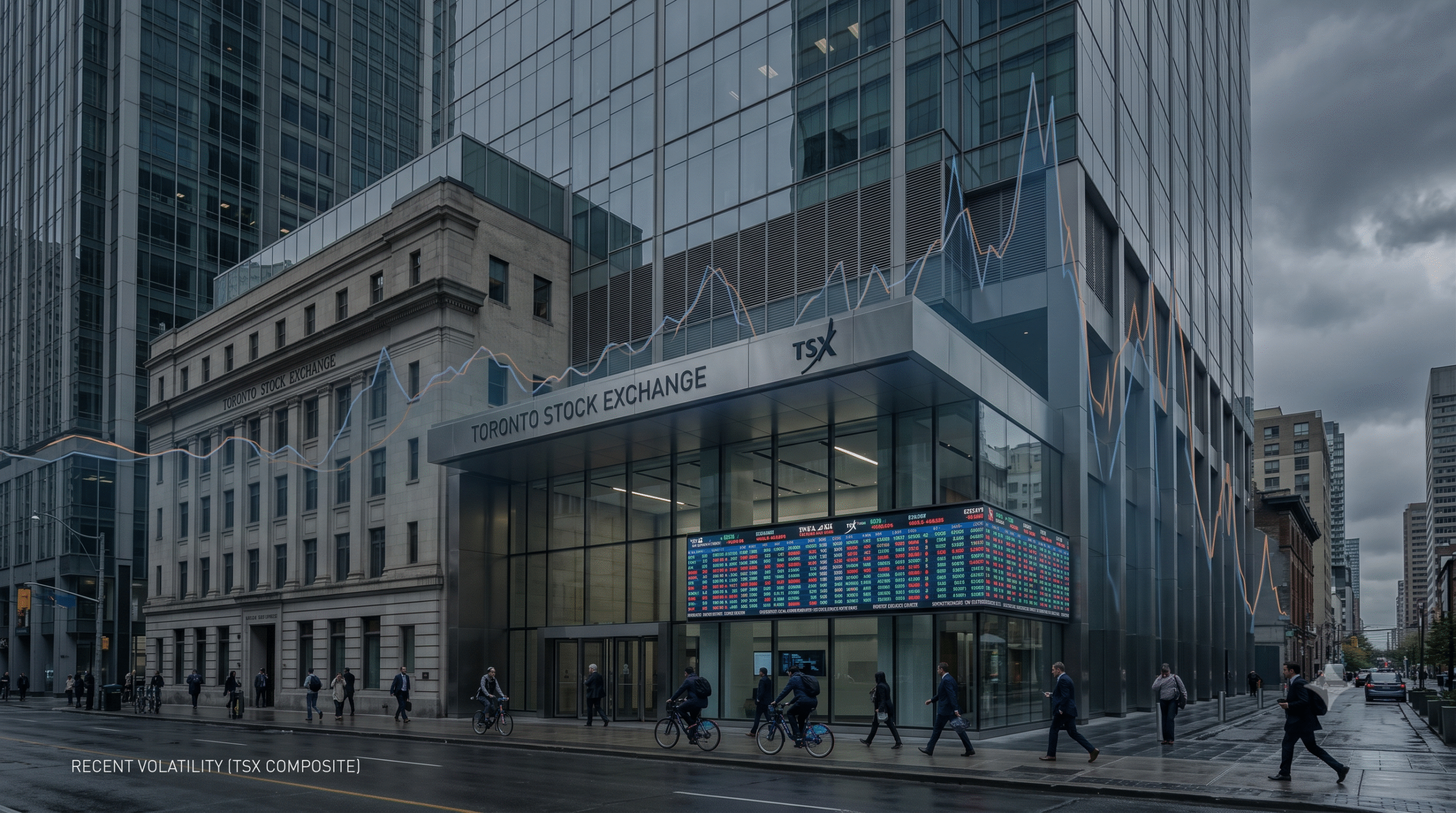
Canadian equities are navigating a genuinely complex crosscurrent in the final days of April 2026. The S&P/TSX Composite has now fallen in four consecutive sessions, settling at 33,584 on Tuesday — registering its second-worst daily decline of the month — and continuing lower into Wednesday morning trade. The composite is currently down roughly 215–220 points on the session as of mid-morning, sitting around 33,364 based on live market data.
The deterioration in sentiment is not driven by a single catalyst but by several reinforcing pressures operating simultaneously. Oil prices crossing US$100 per barrel for the first time in weeks has reignited inflation concerns, leading markets to price in a higher-for-longer monetary policy stance from both the Bank of Canada and the U.S. Federal Reserve. At the same time, AI-related technology stocks — one of the market’s primary sources of upside momentum throughout 2025 and early 2026 — are being broadly repriced lower following a Wall Street Journal report questioning OpenAI’s internal growth trajectory.
Unlock Premium Articles for Exclusive Insights!
You are reading a free article. Enter your details to unlock full access.
By submitting your details unlock full article.
What Happened
Tuesday’s session saw the TSX fall 234 points, or 0.7%, to close at 33,584. The S&P/TSX Capped Energy Index was a notable outlier, rising approximately 1.9% as oil-linked names benefited from WTI’s breach of the US$100 level. However, those gains were far outweighed by losses in technology and mining sectors.
Celestica (TSX: CLS) was the single worst-performing TSX stock on Tuesday, plunging nearly 15% to $493.22 despite reporting 53% revenue growth and raising its full-year outlook — a dramatic example of how AI-sector sentiment can override even strong fundamentals. Lundin Mining, AbraSilver Resource, and Capstone Copper all fell by at least 6.2%, reflecting weakness in the base metals complex. CGI Inc. (TSX: GIB.A) dropped more than 13% on Wednesday after its modest revenue miss in Q1 results.
On the positive side, Baytex Energy (TSX: BTE), Vermilion Energy, Whitecap Resources (TSX: WCP), and Boyd Group Services each climbed more than 4% on Tuesday. ARC Resources, Baytex, Telus, Whitecap, and Enbridge led the exchange in trading volume.
On the macro front, the Canadian government’s financial update this week showed that the federal deficit is improving and consumer spending is continuing to anchor domestic demand. However, exports and business investment remain pressured by tariff uncertainty, and Rogers Communications announced it was offering voluntary departure packages to approximately 25,000 employees — roughly half its workforce — as part of a restructuring effort that reflects the broader labour market pressure building across corporate Canada.

Why It Matters
The Oil-Equity Tension
Normally, Canadian equities — with their heavy resource weighting — would benefit from an oil price surge. The problem in the current cycle is that US$100 oil carries an inflation implication that offsets the direct earnings benefit for producers. When crude reaches triple digits because of a geopolitical conflict threatening supply disruptions in one of the world’s most critical shipping lanes, markets price in not just higher commodity revenues but also tighter monetary policy, slower consumer spending, and increased geopolitical risk premiums across all asset classes.
Earnings Season Complexity
This week is one of the busiest on the Canadian corporate earnings calendar for Q1 2026. The conflicting signals — Celestica’s record results punished, CGI’s miss punished — suggest that the market’s tolerance for disappointment is essentially zero, while the reward for beating is being compressed by sector-wide selloffs. Investors should interpret price action in individual stocks carefully this week, as moves may reflect macro overlays more than company-specific fundamentals.
Sector Breakdown
Energy was the clear winner on Tuesday and continues to outperform in early Wednesday trading. The S&P/TSX Capped Energy Index gained roughly 1.9% mid-morning. Technology and mining were the laggards, with heavy losses in both AI-linked names and base metals. The financial sector was marginally lower — the S&P/TSX Capped Financial Index off about 0.6% — while real estate and utilities also declined modestly.
Across the TSX, the session’s dynamics confirm a familiar defensive rotation: investors moving out of high-beta, growth-oriented names and toward cash-generative energy stocks and dividend-paying infrastructure. This pattern has characterised most of April’s trading and appears likely to persist until either central bank language turns more dovish or the geopolitical situation stabilises.
Risks to Watch
The Bank of Canada and Federal Reserve rate decisions — both due today — represent the most immediate risk event. While no rate changes are expected, any language suggesting fewer cuts ahead or a more persistent inflation concern could accelerate the selling in rate-sensitive equities. The Strait of Hormuz situation remains unresolved, and a further escalation could push oil above US$110 per barrel, adding fuel to both the energy sector’s outperformance and the broader market’s inflation anxiety.
Domestically, the Rogers Communications restructuring announcement — cutting 25,000 positions — is a significant signal about the health of Canada’s labour market and the financial pressures facing large-cap telecom operators. The CAD/USD exchange rate at 0.731 is also worth watching; further CAD weakness would support commodity exporters but add to import cost pressures for consumers and businesses.
What to Watch Next
Today’s BoC and Fed announcements are the macro centrepiece. On the earnings side, the list of reporting TSX companies today is extensive: Whitecap Resources, Methanex, West Fraser Timber, GFL Environmental, Allied Properties REIT, Centerra Gold, Bausch Health, Alamos Gold, Capstone Copper, Kinross Gold, Canadian Pacific Kansas City, Choice Properties REIT, Primaris REIT, Brookfield Infrastructure, Canadian National Railway, Capital Power, CGI, and Winpak are all on the calendar. The breadth of today’s reporting makes it a pivotal session for the overall direction of the TSX heading into May.
Also Read: Best long term Canadian stocks
Final Outlook
The TSX’s four-session losing streak is uncomfortable but not yet alarming relative to the underlying strength that characterised the market through much of the first quarter. The headwinds — oil at US$100, AI sentiment reset, central bank uncertainty, geopolitical risk — are real but not indefinite. Energy’s outperformance suggests the market is finding its own internal balancing mechanism, and a heavy week of earnings may begin to clear the information vacuum that tends to exaggerate price swings.
Also Read: Stock investment Canada for beginners
For investors with a medium-term view, the current bout of weakness may ultimately present more opportunity than risk — particularly in quality dividend names and beaten-up technology stocks with intact fundamentals. But near-term volatility is likely to continue, and the BoC and Fed announcements today will set the tone for the remainder of the week.
Sign Up For our Newsletters to get latest updates