


Table of Contents
- Market Context
- What Happened
- Why It Matters
- Sector Breakdown
- Risks to Watch
- What to Watch Next
- Final Outlook
Market Context
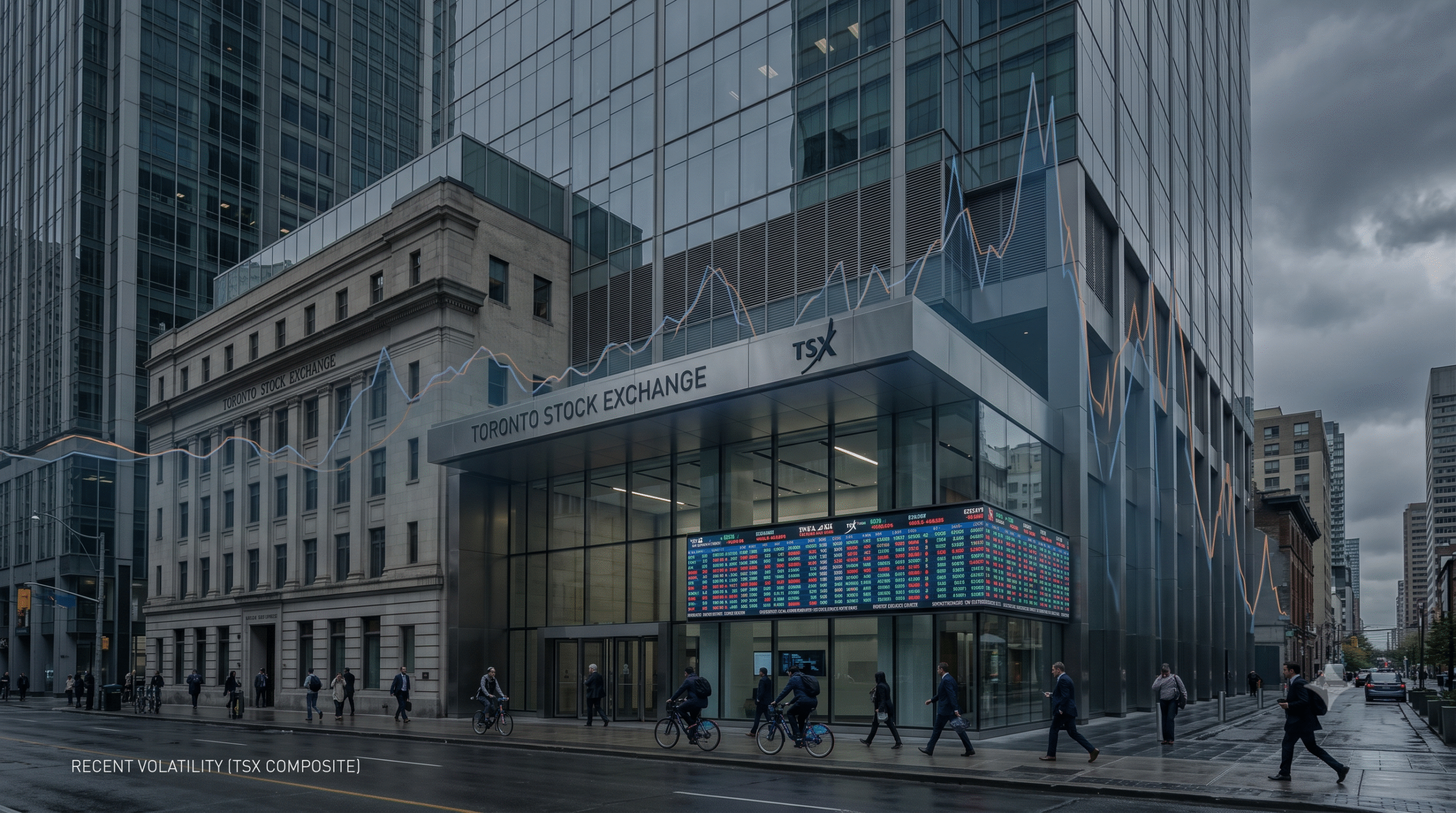
The S&P/TSX Composite posted its first weekly gain in a month for the week ending September 25, 2026 — a milestone that arrives as the final day of September, September 29, brings a fresh formal trade war escalation through the expanded U.S. tariff schedule effective today. The TSX 60 Index declined 3.3% between September 3 and 10, then recovered 1.9% between September 16 and 22, and managed to close Friday September 25 at 35,801 — a 0.3% daily gain and the week’s best session as oil prices eased on Iran progress and banks surged. The index is 20.29% higher year-over-year and –2.75% over the past month, reflecting the September volatility that absorbed a Fed rate hike, Saudi pipeline closure, AI safety debate, and multiple rounds of bilateral tariff escalation in a compressed timeframe.
The analytical achievement of September’s final week is not simply that the TSX gained — it is the breadth and quality of what drove the gains. The first weekly gain came against a backdrop that included Iran’s Hormuz offer generating the most constructive geopolitical signal of the conflict cycle, BlackBerry’s September 24 Q2 fiscal 2027 results exceeding expectations and driving a 3.6% Friday gain after the company raised its full-year outlook, Celestica and Parex each climbing more than 3%, and the banking sector generating one of its strongest collective sessions of September on Friday. Canada’s first Investor Summit, hosted by Prime Minister Carney on September 15, secured CA$500 billion in pledged investment for critical infrastructure in digital technology, energy, and transportation — a domestic capital catalyst that is beginning to flow into specific sector narratives.
Motley Fool Canada’s September 25 analysis of the TSX’s weekly gain framed the context clearly: “The volatility sparked as the US-Canada trade talks fell apart on August 22, 2026, and Canada reciprocated with a ‘dollar-for-dollar’ tariff on September 8. The inflated tariff war did not include major Canadian exports like oil, gas, and gold, but it strained the stock market.” That structural observation — that the TSX’s most important export sectors are not directly affected by the current tariff schedules — is the foundational insight for understanding why Canada’s market has absorbed September’s extraordinary shock sequence while remaining 20.29% above year-ago levels.
What Happened
Friday September 25 delivered a session that captured September’s final week dynamics in a single trading day. BlackBerry gained 3.6% after raising its fiscal 2027 full-year financial outlook following a strong first half. Kinross Gold (TSX:K) plunged 11.3% to CA$34.50 — the TSX’s worst performer — after lowering its 2026 and 2027 production guidance due to extreme weather and operational challenges at La Coipa and Round Mountain. Celestica and Parex Resources each climbed more than 3%. Banks surged: RBC +1.2%, TD +1.2%, BMO +0.8%, Scotiabank +1.5%, CIBC +2.0%. Energy heavyweights fell approximately 1.5% as oil eased on Iran progress. CNQ, Telus, TC Energy, BlackBerry, and Kinross were the week’s five most active TSX stocks by volume. The TSX closed at 35,801, up 0.3%, capping its first positive weekly performance in a month. Today, September 29, the expanded U.S. tariff schedule on Canadian alcohol, dairy, wood, aluminum, and furniture at 50% takes effect.
Why It Matters
BlackBerry’s Raised Guidance Is September’s Most Constructive Technology Signal
BlackBerry’s 3.6% Friday gain after raising its full-year fiscal 2027 financial outlook is analytically significant beyond the single-session price move. When a company that has delivered 128.9% year-to-date gains reports Q2 results that are strong enough to justify raising full-year guidance, it confirms that the market’s extraordinary re-rating from a legacy brand to a physical AI automotive software franchise was supported by genuine fundamental improvement rather than narrative momentum alone. The raised outlook — following Q1’s US$152.9 million in revenue (up 26%), the Coretura/Alloy Kore design win, and the QNX royalty backlog of approximately US$950 million — positions BlackBerry heading into Q4 2026 and calendar 2027 with improved institutional analyst confidence and a more specific financial roadmap.
Kinross’s 11.3% Drop Is the Week’s Most Important Risk Management Lesson
The 11.3% single-session decline in Kinross Gold — driven by operational guidance cuts at two mines experiencing extreme weather and site-specific challenges — is September’s most concentrated single-stock risk event. La Coipa in Chile and Round Mountain in Nevada are both assets with unique geographic and environmental risk profiles. Kinross’s guidance cut is specific to those sites and does not reflect a sector-wide production challenge, but the stock market’s severe reaction illustrates the asymmetric downside risk embedded in high-multiple gold mining equities when operational guidance deteriorates. For investors in gold mining names — particularly those trading at premium multiples after the year’s extraordinary gold price performance — the Kinross event is a reminder to assess individual mine-level operational risk, not just commodity price direction and financial metrics.
Sector Breakdown
The TSX’s Q4 positioning snapshot as of September 29 reflects a market that has confirmed several important structural truths through September’s volatility. The financial sector — banks specifically — has demonstrated that its Q3 fiscal 2026 earnings quality provides a genuine cushion beneath macro-driven selling pressure, and that when inflation expectations ease even modestly, bank stocks respond constructively. The technology sector — BlackBerry’s raised guidance, Celestica’s AI hardware momentum — confirms that company-specific Canadian technology growth continues to generate fundamental momentum independent of the macro environment. The gold mining sector faces a bifurcated picture: senior producers with diversified operational portfolios (Agnico Eagle) provide more resilient earnings profiles than single-jurisdiction or operationally challenged producers (Kinross). The energy sector is normalising from emergency premium pricing toward structural value levels.
Risks to Watch
September 29’s tariff expansion is the formal trade escalation risk of the day — investors should monitor whether the U.S. or Canadian government makes any additional announcements alongside the implementation. The Iran-U.S. naval agreement remains the energy and inflation pivot point: a completed deal would extend Friday’s credit-sector gains; a breakdown would reassert the oil spike risk. October FOMC meeting probability — and the data that will inform it — creates sustained rate uncertainty. Kinross’s operational situation — while specific to La Coipa and Round Mountain — warrants monitoring at peer gold producers for any similar weather or operational challenges that could produce further guidance revisions in the sector.
Also Read: Top Canadian tech AI stocks
What to Watch Next
This week’s Iran-U.S. naval agreement developments are the most important near-term catalyst for TSX direction broadly. Canada’s September retail sales data — released Friday, with the TSX watching closely — will provide the first post-tariff consumer spending read. Bank of Canada Governor Macklem’s October speech circuit will be monitored for any evolution from his September 21 sub-1% Q4 growth warning. October 28’s Bank of Canada rate decision is the autumn’s most important domestic monetary policy event. November U.S. midterms are the diplomatic reset marker for Canada-U.S. trade talks.
Final Outlook
The TSX’s first weekly gain in a month confirms that September’s macro shock sequence — while severe — has not broken the structural bullish thesis for Canadian equities. The index at 35,801 remains 20.29% above year-ago levels, and the breadth of last week’s recovery — spanning technology, banks, energy services, and selected materials — suggests genuine institutional buying rather than short covering alone. September 29’s tariff expansion is today’s formal escalation event, but the Iran diplomatic progress, BlackBerry’s raised guidance, and the Canada Investor Summit’s CA$500 billion investment pipeline confirm that the constructive forces are also real and building.
Verdict: Cautiously constructive heading into Q4. The first monthly weekly gain represents genuine recovery of institutional confidence. Position around the Iran diplomatic binary and October 28 BoC decision as the two events most likely to define the TSX’s Q4 trajectory. Maintain diversification across banks, technology, and energy as September’s internal sector rotation confirms each category’s distinct value in a complex macro environment.
Sign Up For our Newsletters to get latest updates