


Table of Contents
- Market Context
- What Happened
- Why It Matters
- Sector Breakdown
- Risks to Watch
- What to Watch Next
- Final Outlook
Market Context
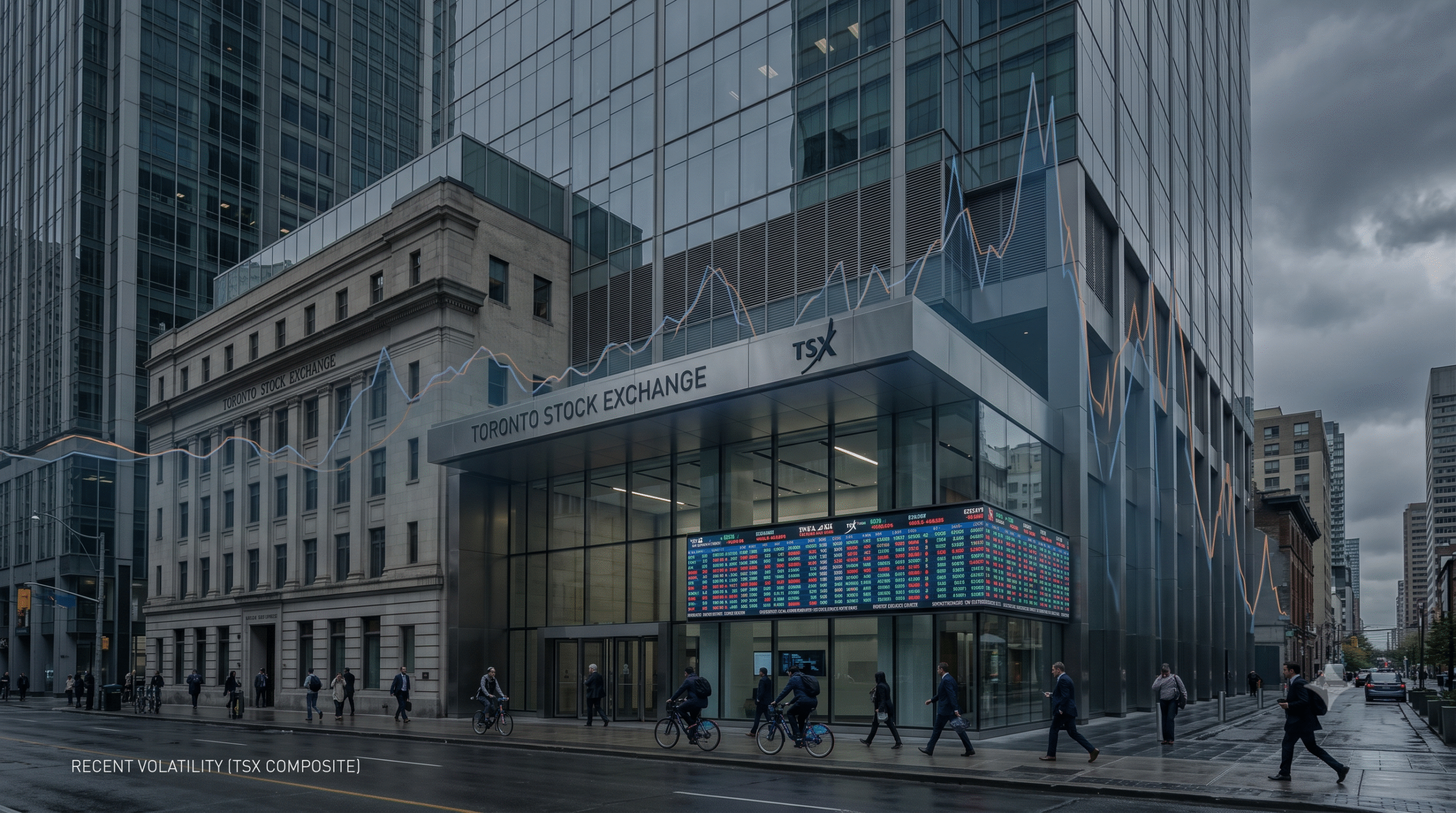
The S&P/TSX Composite Index closed at 36,335.61 on Tuesday September 22, up 326.21 points or 0.93% — its strongest single-session gain since early September and one that fundamentally changes the market context heading into Wednesday’s most important catalyst: BlackBerry’s Q2 fiscal 2027 earnings at 8:00 a.m. EDT. The index is now 21.89% higher year-over-year, and the TSX’s rolling one-month decline of 1.01% is considerably more modest than it appeared after Friday’s muted close. Tuesday’s rally was driven by a convergence of genuinely constructive signals: Iran offered to reopen the Strait of Hormuz within seven days conditional on U.S. military pressure easing; oil fell on that diplomatic signal, reducing energy-driven inflation expectations; banks and credit-sensitive names gained as rate-hike odds declined; and materials names advanced despite wavering gold, with Agnico Eagle and Barrick each gaining approximately 1%.
The week of September 22 has delivered a set of market events that, in aggregate, represent a partial resolution of the competing forces that have defined September’s extraordinary volatility. The Fed’s September 16 hike is digested. The hawkish dot-plot’s message — at least one more 2026 hike — is priced. Hormuz diplomacy is actively progressing for the first time since the conflict began. Prime Minister Carney confirmed at the UN General Assembly that potash “will continue to be a strength of our economy,” and Trump simultaneously said the U.S. will continue buying Canadian potash — a bilateral confirmation that the most aggressive forms of agricultural commodity leverage are off the table on both sides. That de-escalation, while not a trade war resolution, removes one category of worst-case scenario that markets had been pricing into Canadian resource names.
Against this constructive macro backdrop, BlackBerry (TSX:BB) surged 8.2% in pre-market trading on Tuesday after QNX and partner Vector announced that Coretura — the software-defined vehicle platform company founded by Daimler Truck and Volvo Group — selected Alloy Kore as the foundational software layer for its next-generation commercial vehicle platform. That announcement, combined with CNBC’s Jim Cramer’s buy call and RBC Capital analyst Paul Treiber’s reiterated Sector Perform rating with a CA$9.00 price target, created a powerful pre-earnings setup for Wednesday’s actual results. The stock has delivered a 128.9% year-to-date return per Simply Wall St analysis, and Wednesday’s earnings will test whether that re-rating is supported by Q2 financial results.
Also Read: Stock investment Canada for beginners
What Happened
The most consequential events of the past 24 hours for TSX investors are: Iran’s Hormuz offer (sent oil to US$90.52, –US$1.85); BlackBerry’s Coretura/Alloy Kore design win announcement (stock +8.2% pre-market Tuesday); TSX’s 326-point gain; Prime Minister Carney’s UNGA potash statement; Trump’s UNGA potash confirmation; BoC Governor Macklem’s Monday warning that Q4 growth could fall below 1%; Aecon Group’s CA$3 billion contract wins and CA$0.192 dividend declaration; the Canadian dollar declining to 71.10 cents US; RBC, TD, and Scotiabank each gaining approximately 0.5%; and miners recovering with Agnico Eagle and Barrick each gaining approximately 1%. On the negative side, energy stocks absorbed oil’s decline: CNQ fell 2.2% and Suncor shed 2.7%. The net result is a market that is repositioning from a geopolitical-oil-inflation framework toward a potential diplomatic-resolution-and-growth framework — exactly the rotation that benefits financials, technology, and diversified industrials while normalising energy’s exceptional outperformance.
Why It Matters
The Hormuz Offer Resolves the Market’s Binary Risk — Even If Imperfectly
Iran’s seven-day Hormuz offer is not a ceasefire, and the U.S. government’s formal response — which was not yet known at Tuesday’s close — may introduce conditions or timelines that complicate the apparent simplicity of the offer. But the analytical significance of the offer is that it changes the market’s binary risk assessment. For months, investors have been pricing either “conflict continues indefinitely” (sustaining the oil supply premium) or “sudden ceasefire” (rapidly removing it). The seven-day conditional offer introduces a third path: a structured, graduated de-escalation with defined prerequisites and timelines. That middle path is actually more constructive for equities broadly than either binary extreme, because it implies a controlled and predictable transition rather than a sudden shock in either direction.
Carney-Trump Potash Alignment Is the Most Specific Trade War De-Escalation Signal of the Week
The combination of Prime Minister Carney’s UNGA statement that potash “will continue to be a strength of our economy” and Trump’s simultaneous confirmation at the UNGA that “his country will continue buying Canadian potash” represents the most specific and bilateral trade de-escalation signal since the trade war’s September escalation began. On September 21, Trump had announced working on a “massive deal” to purchase potash from Belarus — a signal that markets interpreted as threatening Canadian potash leverage. Within 24 hours, both leaders had publicly reaffirmed the bilateral potash trade relationship at the UN’s most visible annual forum. That sequential re-affirmation is not a trade war resolution, but it is a meaningful narrowing of the bilateral dispute’s potential scope.
Sector Breakdown
Tuesday’s TSX sector performance provides a complete snapshot of the market’s re-positioning in response to Hormuz diplomacy. Technology — BlackBerry’s pre-market surge, continued strength in AI names ahead of Wednesday’s earnings, Constellation Software’s quiet advance — was a primary contributor to the 326-point gain alongside basic materials. Financial stocks — bank names gaining 0.5% — confirmed the rate-hike-probability-reduction thesis. Energy — CNQ and Suncor declining — bore the direct cost of the oil price normalisation that the Hormuz offer catalysed. Materials — Agnico Eagle and Barrick recovering — reflected the net positive impact of removing the inflation-rate-hike headwind from gold more completely than the removal of the safe-haven bid.
Risks to Watch
The Hormuz diplomatic process has failed before: the Oman meeting scheduled for mid-September was postponed when Iran and Gulf state envoys failed to convene. A similar breakdown in the current UNGA-facilitated process would reverse Tuesday’s oil price decline and reassert the inflation-rate-hike narrative. BlackBerry’s Wednesday earnings — while set up by Tuesday’s Alloy Kore win and the improved macro backdrop — still carry execution risk: a revenue miss relative to the Q1 trajectory of US$152.9 million would trigger a sharp correction regardless of the pre-earnings momentum. September 29’s tariff expansion — now six days away — remains the next formal trade escalation event. Macklem’s sub-1% Q4 growth warning adds a domestic economic slowdown risk that is independent of oil price movements.
What to Watch Next
BlackBerry’s September 24 earnings at 8:00 a.m. EDT are tomorrow’s most important Canadian market event. The U.S. government’s formal response to Iran’s Hormuz offer — expected through UNGA channels this week — will determine whether Tuesday’s oil decline is sustained or reversed. September 29’s tariff expansion effective date is the next formal trade policy milestone. Bank of Canada October 28 decision will respond to whatever combination of Hormuz resolution and tariff damage has materialised by then.
Final Outlook
Tuesday’s 326-point TSX gain represents a genuine and data-supported market advance rather than speculative optimism. The Hormuz diplomatic offer, the potash bilateral reaffirmation, and BlackBerry’s Alloy Kore design win collectively provide three specific and fundamentally grounded catalysts for Tuesday’s advance. The market at 36,335.61 — 21.89% above year-ago levels — is expressing appropriate confidence in Canadian corporate quality while remaining alert to the binary risks ahead.
Wednesday’s BlackBerry earnings and the Hormuz diplomatic response are the two variables that will determine whether Tuesday’s advance builds into a sustained recovery or proves to be an opportunity for institutional profit-taking.
Verdict: Cautiously constructive heading into Wednesday. The macro backdrop is more supportive than at any point in the past two weeks. BlackBerry earnings and Hormuz response are Wednesday’s binary events that will define the TSX’s direction through the end of September.
Sign Up For our Newsletters to get latest updates