


Table of Contents
- Market Context
- What Happened
- Why It Matters
- Sector Breakdown
- Risks to Watch
- What to Watch Next
- Final Outlook
Market Context
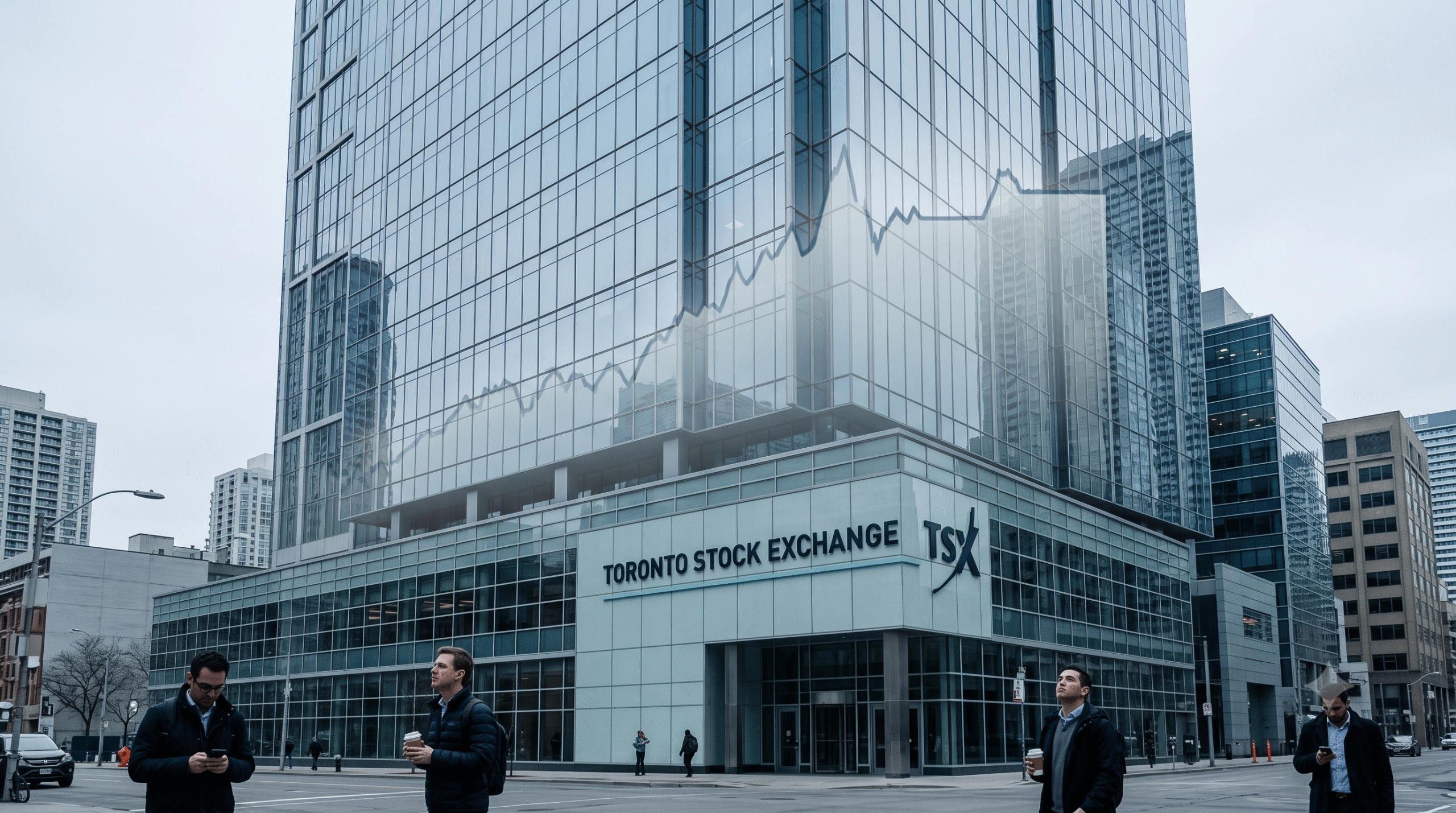
The S&P/TSX Composite Index closed at 35,464.37 on Tuesday September 15 — a decline of 0.67% on the session — and TSX futures pointed modestly lower again heading into Wednesday September 16’s Federal Reserve rate announcement at 2:00 p.m. ET. The index is now approximately 3.5% below its August 25 record high of 36,957.63, having given back the equivalent of roughly two months of gains in three weeks of geopolitical and monetary policy turbulence. Yet within that index-level number lies a set of sector and individual stock divergences that are analytically more important than the composite number itself for investors making allocation decisions ahead of the FOMC decision.
Tuesday’s session data from Trading Economics confirms the specific internal dynamics: real estate shares fell 1.6% and consumer discretionary stocks slipped 2.0% — the two most rate-sensitive and consumer-dependent sectors bearing the heaviest sectoral losses. Energy was among the only positive sectors, continuing its role as the market’s primary beneficiary of the Saudi East-West pipeline closure and sustained oil above US$100. Gold mining stocks absorbed sharp individual-name losses with Agnico Eagle and Barrick each falling approximately 3% and WPM shedding 3.5% — an unusually severe gold mining correction driven by the 10-year Treasury yield’s breach of 5%. And in what is emerging as one of the most analytically interesting individual stock stories of September, Celestica (TSX:CLS) tumbled nearly 7% on September 14 on profit-taking following a major leadership shakeup that elevated longtime CFO Mandeep Chawla to Group President, Global Markets — a move that initially reinforced confidence in the company’s multi-year growth plan before profit-taking overwhelmed the positive sentiment.
Canada’s August CPI, released Monday September 14, showed annual inflation unchanged at 3.0% — in line with market expectations — with price growth dominated by energy goods. Core inflation measures tracked by the Bank of Canada remained close to target, providing the BoC with the data support for maintaining its hold posture while the Fed navigates its own decision.
What Happened
Celestica (TSX:CLS) tumbled nearly 7% on September 14 after investors took profits following a leadership announcement that elevated CFO Mandeep Chawla to Group President, Global Markets. The move — which the company characterised as reinforcing confidence in its multi-year growth plan — triggered selling rather than buying, a “sell the event” dynamic that reflects the stock’s extraordinary year-to-date gains and the elevated bar that premium-multiple companies face when any announcement creates an opportunity for profit-taking. The nearly 7% decline follows the stock’s earlier extraordinary guidance revision — 190% Enterprise segment revenue growth targeted for Q3, CA$11.30 adjusted EPS for 2026, CA$600 million FCF target — and the AI safety commentary from Anthropic and OpenAI CEOs that had already introduced uncertainty into the AI hardware demand narrative. Agnico Eagle and Barrick each fell ~3% and WPM shed 3.5% on September 15 as gold’s rate-pressure correction extended. Real estate REITs — including various Canadian real estate investment trusts — declined 1.6% as the 5% 10-year yield made their leveraged business models more expensive to finance and their yield profiles less competitive versus government bonds. Canadian major banks including TD, BMO, and Scotiabank moved lower in pre-market trading on September 15 amid oil price rebounds and Fed rate-hike expectations, though the sector’s Q3 earnings quality provides a fundamental anchor beneath the macro-driven selling.
Also Read: Safe investments for new investors
Why It Matters
Celestica’s 7% Decline Is a Premium Multiple Lesson, Not a Business Deterioration Signal
Celestica’s near-7% decline on a leadership announcement that is being characterised positively illustrates the fundamental challenge of owning premium-multiple stocks in a rising rate environment. When a stock trades at a forward P/E of 27.7 times — as Celestica does — any news event that could be interpreted as creating uncertainty (even uncertainty about continued positive momentum) provides an opportunity for investors to reduce positions at high prices before a potential rate-driven multiple compression materialises. The leadership change itself — elevating a respected CFO to an expanded role — is not a negative for Celestica’s business fundamentals. But the stock’s premium valuation means that even positive operational developments can be met with profit-taking if they coincide with a macro environment of rising rates and AI sector uncertainty.
The Real Estate Sector’s 1.6% Decline Is the Most Rate-Mechanical TSX Move
Canadian REITs and real estate companies are among the most directly rate-sensitive assets in the TSX universe because they finance their property assets with long-term debt, distribute most of their income as dividends that must compete with bond yields, and are valued primarily on their net asset value adjusted for the cost of capital. When the 10-year Treasury yield moves above 5%, every real estate company faces three simultaneous headwinds: higher refinancing costs, a compressed yield premium over bonds, and a lower net asset value because property cap rates are discounted at higher rates. Tuesday’s 1.6% REIT sector decline is the direct mechanical expression of 5% government yields working through the real estate sector’s financial structure.
Sector Breakdown
The TSX’s sector structure on September 16 provides a comprehensive map of rate sensitivity across Canada’s investment landscape. Energy — positive on Tuesday and positive throughout the Saudi pipeline closure period — is the least rate-sensitive major sector because its revenues are commodity-driven rather than interest-rate-dependent, and WTI above US$100 is generating free cash flow across the sector at extraordinary rates. Materials — specifically gold mining — is rate-sensitive in the opposite direction from energy: higher rates hurt gold, which hurts miners. Financials — banks specifically — carry a complex dual rate sensitivity where higher rates improve net interest margins but raise credit quality concerns and market competition for income investor dollars. Technology — including Celestica, Shopify, Constellation Software — carries the highest multiple-related rate sensitivity because their valuations are most dependent on long-duration earnings streams discounted at the higher rate. Real estate carries the most direct financing-cost rate sensitivity. Consumer discretionary reflects the household spending impact of the rate-induced slowdown in the broader economy.
Risks to Watch
Today’s FOMC dot-plot is the defining risk event for the TSX’s sectoral balance. A dovish dot-plot — one additional 2026 hike signalled — would immediately reverse much of the technology, real estate, and gold mining pressure by suggesting the rate cycle is near its peak. A hawkish dot-plot — two or more additional 2026 hikes signalled — would extend the compression in every rate-sensitive sector while further lifting energy’s relative attractiveness. Celestica’s September 24 BlackBerry earnings — and Celestica’s own October Q3 results — will be the technology sector’s most important fundamental tests. Canada’s September 29 tariff expansion effective date will be the next formal trade escalation event affecting consumer discretionary and manufacturing sector stocks.
What to Watch Next
The FOMC rate announcement at 2:00 p.m. ET today is the TSX’s most important single event of the week. Bank of Canada Governor Macklem’s scheduled remarks Wednesday will frame the domestic rate path. BlackBerry’s September 24 earnings are the TSX technology sector’s most anticipated company-specific catalyst. The TSX30 2026’s composition — which will be analysed for sector concentration signals — will provide a post-summer read on which themes institutional capital has most consistently rewarded. Real estate sector leaders’ next quarterly updates will quantify the impact of the 5% yield environment on refinancing costs and net asset values.
Final Outlook
The TSX at 35,464.37 on September 15 is a market in active rate repricing — not a market experiencing fundamental earnings deterioration. Canada’s Big Six banks reported exceptional Q3 results three weeks ago. Celestica’s earnings guidance remains one of the most impressive of any TSX company in 2026. Energy sector free cash flow at WTI above US$100 is generating extraordinary returns for producers and the national economy alike. The rate repricing is real, mechanical, and ongoing — but it is working through a TSX that has genuine underlying earnings quality to sustain it.
Today’s FOMC resolution — and specifically the dot-plot’s signal about the future rate path — will determine whether the current correction is near its end or has further to run.
Verdict: Cautiously constructive on the TSX overall, with sector positioning critical. Energy remains the strongest near-term hold; gold names offer medium-term value at current levels for patient investors; technology (including Celestica) warrants monitoring the dot-plot before adding; real estate should be approached with caution until the rate environment stabilises.
Sign Up For our Newsletters to get latest updates