


Table of Contents
- Market Context
- What Happened
- Why It Matters
- Sector Breakdown
- Risks to Watch
- What to Watch Next
- Final Outlook
Market Context
The global financial market environment on September 15 is defined by one near-certainty and one profound uncertainty. The near-certainty: the Federal Reserve will raise its policy rate by 25 basis points on Wednesday, September 16, with money markets pricing approximately 87% probability — the highest conviction of the entire 2026 hiking cycle and a dramatic shift from the balanced debate of just two weeks ago. The profound uncertainty: the Fed’s dot-plot projections for future rate increases — specifically how many additional hikes Chair Warsh signals for the remainder of 2026 and into 2027 — will determine whether Wednesday’s decision is a one-and-done adjustment or the beginning of a sustained tightening sequence that will reshape equity valuations, bond yields, and the Canadian dollar well into 2027.
The financial market setup for Tuesday’s session is unfavourable across most major categories. TSX futures were pointing lower as of Monday evening, extending the pressure that has built since the Saudi East-West pipeline closure sent Brent to US$109.80 intraday and pushed diesel prices to all-time highs. In Asian markets, the Nikkei fell 518 points to 63,492 on Monday, the Shanghai Index dipped 2 points to 3,885, and the South Korean Kospi fell 3.6% to 1,050 — a sharp move in the Asian small-cap and semiconductor complex that reflects both the AI safety commentary from Anthropic, OpenAI, and Elon Musk (discussed in detail in the AI article) and the broader global risk-off mood from US$108 oil. In Europe, the German DAX fell 128 points to 25,440 while London’s FTSE 100 rose modestly.
For Canadian financial sector names specifically — the Big Six banks, Brookfield Asset Management, insurance companies, and pipeline infrastructure — the current environment creates a complex set of simultaneous effects. Higher interest rates benefit bank net interest margins in theory but raise credit quality concerns and mortgage renewal stress in practice. Higher oil prices improve the creditworthiness of energy sector loan portfolios but raise energy-driven inflation that pressures consumer spending and household finances. Rising bond yields offer higher investment income for insurance companies but compress their equity book values and create mark-to-market losses on fixed-income portfolios. These cross-currents are being navigated simultaneously by the same institutions that reported the strongest Q3 fiscal earnings cycle in recent memory just three weeks ago.
What Happened
On September 14, TSX-listed financial sector names participated in a broad market session led by technology, mining, and healthcare. Thomson Reuters (TSX:TRI) bounced after announcing a combined US$1.3 billion U.S. note and CA$1 billion Canadian note offering, using proceeds to reduce existing debt — a capital structure management action that investor confidence welcomed, lifting the stock. Element Fleet Management (TSX:EFR) exited a high-profile bidding war for Fleetpartners, specifically electing to refocus on its core fleet management business — a capital discipline signal that investors are watching for its implications on Element’s future acquisition pipeline. WELL Health Technologies (TSX:WELL) named a new Chief Financial Officer, providing an operational confidence signal for the digital health company’s next growth phase. The broader TSX financial sector was positive on Monday as global risk sentiment improved from Friday’s partial recovery, though Tuesday’s futures indicate that the Saudi pipeline closure’s stagflation implications are reasserting themselves as the dominant market narrative heading into Wednesday’s FOMC.
Why It Matters
The Dot-Plot Is More Important Than the Rate Decision Itself
The 87% probability of a 25-basis-point rate hike on Wednesday has been so thoroughly priced by money markets that the hike itself will produce minimal surprise reaction. What will generate the week’s most important market moves is the dot-plot release — the Fed’s projection of where the median FOMC participant expects rates to be at the end of 2026, 2027, and beyond. If the dot-plot shows only one additional hike beyond Wednesday in 2026, markets will interpret that as a more dovish path than feared and equity markets may rally. If the dot-plot signals two or more additional hikes, the equity market reaction — particularly in rate-sensitive sectors including utilities, REITs, and dividend stocks — would be sharply negative. Canadian financial markets, whose bond yields move in sympathy with U.S. Treasury yields through rate differential dynamics, will feel the dot-plot’s signal acutely regardless of what the Bank of Canada’s own posture is.
Thomson Reuters’ Debt Refinancing Is a Quality Corporate Finance Signal
Thomson Reuters’ decision to issue US$1.3 billion in U.S. notes and CA$1 billion in Canadian notes — using proceeds to pay down existing debt — is a corporate finance action that deserves analytical credit. At a moment when interest rates are rising toward new 2026 highs, a company that proactively refinances to reduce floating-rate debt exposure and lock in fixed-rate liabilities at current terms is demonstrating balance sheet prudence. The stock’s bounce on the announcement confirmed that investors viewed the capital management action positively — a signal that, in the current environment of elevated financing uncertainty, proactive debt management is being rewarded.
Sector Breakdown
The TSX financial market sector on September 15 reflects the complex cross-currents described above. The Big Six banks — RBC, TD, BMO, Scotiabank, CIBC, National Bank — carry the dual macro sensitivity of rate hike benefits (net interest margin expansion) and rate hike risks (credit quality deterioration, mortgage renewal stress). Their Q3 fiscal 2026 earnings — completed just three weeks ago — confirmed exceptional underlying strength, but the Q4 fiscal period has already been affected by September 8’s retaliatory tariffs and the escalating energy price environment. Brookfield Asset Management’s AUM-compounding model continues to benefit from infrastructure capital deployment at higher oil prices, as energy transition assets — Brookfield Renewable’s assets particularly — gain strategic attractiveness. Thomson Reuters’ debt management action places it in a stronger financing position heading into a higher-rate environment. Element Fleet Management’s exit from the Fleetpartners bidding war signals capital discipline that reduces dilution risk for existing shareholders.
Risks to Watch
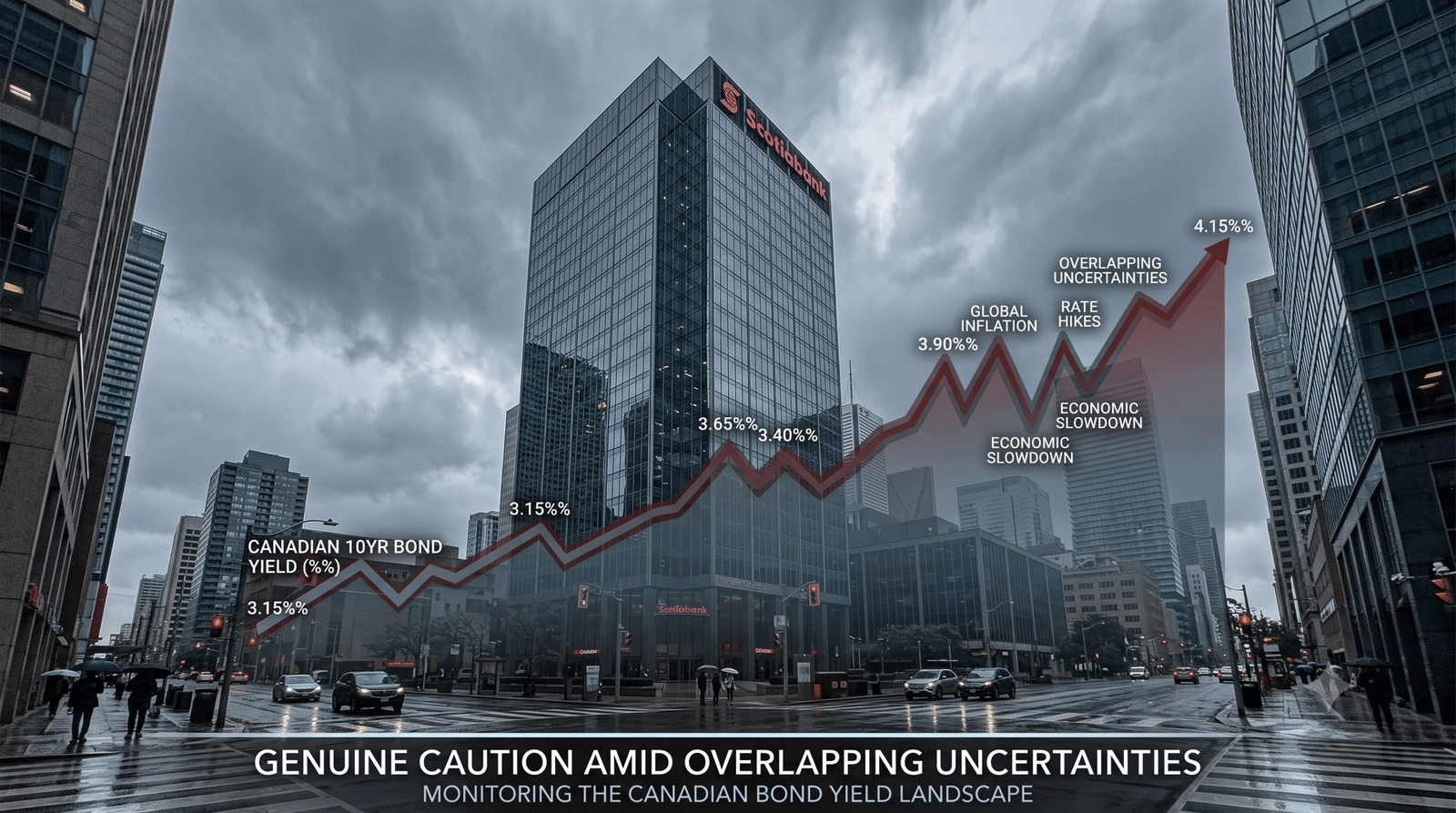
The most concentrated risk for the Canadian financial market is Wednesday’s dot-plot projection. Two additional hikes signalled beyond Wednesday would push the Federal Reserve’s terminal rate significantly above current levels, driving Canadian bond yields higher and compressing dividend equity valuations across banks, utilities, and pipelines. Canada’s September 29 tariff expansion effective date — adding 50% duties on a wider range of Canadian goods — creates the next formal trade war escalation event that financial sector credit quality teams must prepare for. The one-third of Canadian mortgage holders facing renewal at current or higher rates by year-end carries a slow-burning credit quality risk that is approaching its most acute phase precisely as rates are reaching their highest 2026 levels. Diesel at all-time highs creates transportation and logistics cost inflation that affects virtually every sector in Canadian bank loan books.
Also Read: Stock investment Canada for beginners
What to Watch Next
Wednesday’s FOMC rate announcement at 2:00 p.m. ET — with dot-plot and press conference — is the week’s defining event for the TSX financial sector. Bank of Canada Governor Macklem is scheduled to speak Wednesday — investors should watch for any updated language on the domestic rate path following the Fed’s decision. Thomson Reuters’ use of its debt offering proceeds — and the pace of deleveraging — will be a follow-up signal for capital markets investors. Element Fleet Management’s next capital allocation announcement will confirm whether its exit from the Fleetpartners bidding war signals a broader shift in M&A strategy. Brookfield’s August 5 Q2 results had already been released; its next catalyst is Q3 earnings expected in November.
Final Outlook
The TSX financial market enters Wednesday’s FOMC in a state of well-prepared but genuinely uncertain positioning. The 87% hike probability means Wednesday’s decision will not surprise; the dot-plot’s language about the future rate path will. Canadian banks’ fundamental earnings quality — confirmed emphatically in the Q3 fiscal cycle — provides a strong foundation beneath the rate-sensitivity concerns that are generating near-term stock price volatility. Thomson Reuters’ debt management action and Element Fleet’s capital discipline signal confirm that corporate Canada’s financial sector is making quality decisions under pressure.
The week’s resolution — through Wednesday’s FOMC dot-plot and press conference — will define the financial sector’s positioning for Q4 2026 more clearly than any development since the Bank of Canada’s September 2 hold.
Verdict: Cautiously constructive on Canadian financial sector names. Big Six bank earnings quality is the sector’s most durable anchor. Monitor Wednesday’s dot-plot for the rate trajectory that will determine whether the current multiple compression in financial stocks represents a near-term buying opportunity or a sustained re-rating. Thomson Reuters and Element Fleet management actions are constructive corporate governance signals within the non-bank financial universe.
Sign Up For our Newsletters to get latest updates